Back to all stories
Adyen
Adyen, the payments platform behind Uber, Starbucks and Netflix, replaced a legacy source-to-pay suite with Omnea as the entry point for every supplier, contract and risk request. Sixteen weeks after signing, almost 5,000 employees across 29 offices went live with a single announcement email. Average cycle times have since fallen by 45%, the old suite has been retired, and the procurement team is building its first AI agents on a stack it controls.
Implementation for almost 5,000 employees in 29 offices
Reduction in average end-to-end cycle time
Requests through Omnea in the first three months
At a glance
People reshaping Adyen

Challenge
Built by Finance, before Procurement existed
In February 2024, Adyen's procurement team and its first source-to-pay suite arrived together. Finance had led both the selection and the implementation, and the new tool set an operating model for the whole company: every supplier had to be fully onboarded before an invoice could be processed. It became the intake for more than 1,000 requestors and the portal for thousands of vendors. The scale changed fast. Managing around 600 high-risk suppliers with a few added each month is one job. Managing more than 4,000 suppliers with hundreds of requests a month is another, and the new team was not set up for it. Adyen built the function out in response, adding a category structure, category managers for different parts of the business and a Procurement Excellence team to own the processes and iterate on the system. The system itself was the next problem.
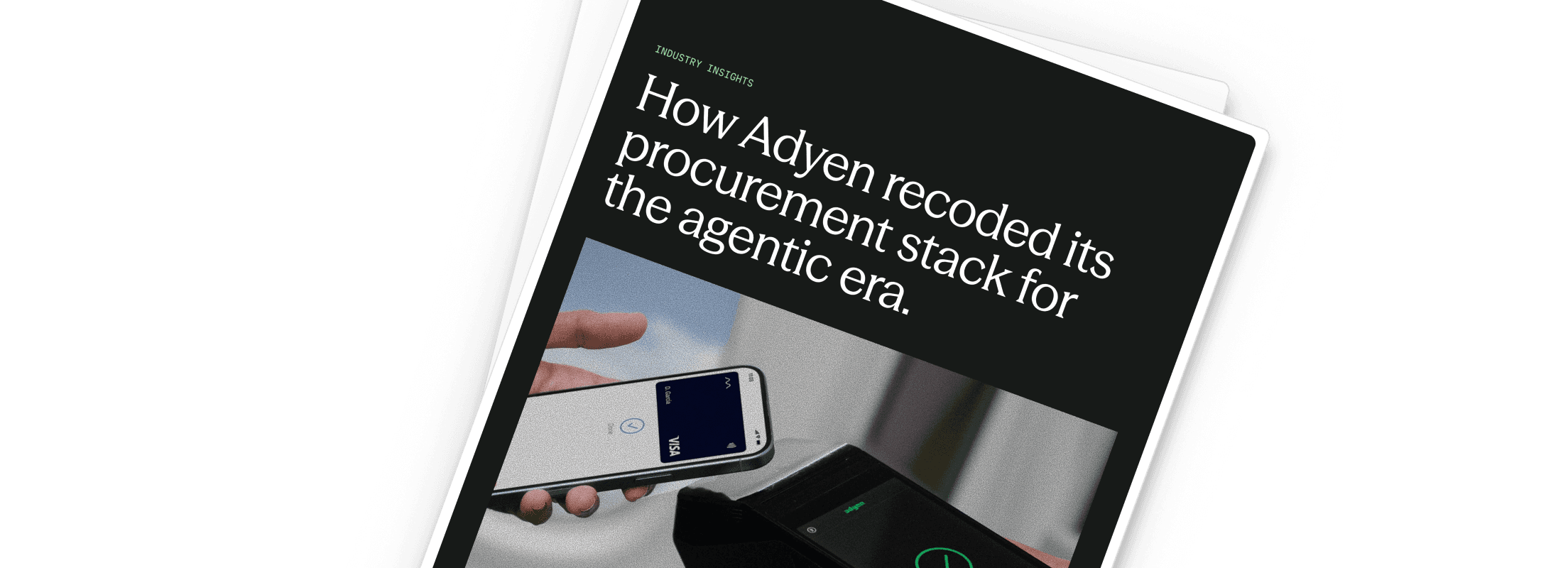
Read the full story in Adyen's whitepaper →
A system that needed training before anyone could use it
The S2P was not intuitive. Users needed mandatory training before they were given access, and many requests still arrived with errors. Once a request was submitted, the requester lost sight of it: no view of the next step, no idea who owned it. That gap turned into dozens of questions a day in the internal support channel and hours each week answering them. In a company growing more than 20% a year, with over a thousand requesters across 29 offices, most people only raise a few requests a year. Heavy users can be trained on any tool. Occasional users need one that works the first time.
"Users had no indication of where their request was in the process once submitted, so once again, Procurement had to act as a Sherpa, explaining where a request stood and what still had to happen to get a deal done."
Gabriel Galdino and Sam Kaserer, Adyen procurement team
Weeks to change a workflow
Configuration changes were complex and slow. Reworking the commodity structure, the risk scoring or the conditional logic between steps took weeks, sometimes months, even after Adyen hired a specialist with prior experience of the system. Every change had to be prioritized ruthlessly against every other. The result was an inflexible roadmap and frustration on both sides: for the users waiting on fixes, and for the procurement team that could not deliver them.
Two modules that didn't talk
As a financial services company with banking licenses in several regions, Adyen is highly regulated, and third-party risk management is the most important step in its procurement process. The S2P ran it in a separate TPRM module, apart from the central module for intake, sourcing, contracts and P2P. Most requests needed both, and the two did not communicate. Manual steps were needed to launch a task in one module from the other, and users had to come back a second time to answer basic risk questions.
Each issue was manageable on its own. Together, they were costing Adyen the scarcest resource in any fast-growing company: time. Time the procurement team wanted to spend on strategic supplier relationships, and time requesters wanted back so they could get on with the work that fuels Adyen's growth.
"When combined, the issues were costing Adyen too much of the scarcest resource at any fast growing company: time."
Gabriel Galdino and Sam Kaserer, Adyen procurement team
Solution
Five orchestration tools and one non-negotiable
Adyen's first plan, pitched at the end of 2024, was an intake and orchestration layer on top of the S2P: a better experience for requesters, higher adoption, and hundreds of monthly requests taken off an overstretched team. After a market screening, the team shortlisted five procurement orchestration tools. No established S2P suite made the list, because none was considered AI native. One requirement outranked every other: TPRM. Adyen also wanted a platform that could sit on top of the existing S2P now, with the ambition of replacing it later.
One by one, the alternatives fell away. One vendor had no plans to connect directly to ERPs. Two lacked the TPRM depth Adyen needed for its evolving due diligence requirements. The last was not user-friendly enough to justify the investment. Omnea met every success criterion, and the team found something it says procurement often overlooks when selecting suppliers: cultural fit. Omnea's habit of co-building the platform with customers, its experience with other fintechs, the proximity of the two teams and the people Adyen met along the way all built trust that this was a long-term partnership rather than a sale. Adyen chose Omnea at the end of 2025.
"Through the review process, Omnea emerged as the clear choice. The platform met all of our success criteria, and we also found a partner with a strong cultural fit."
Sam Kaserer, Senior Procurement Manager, Adyen
Live in 16 weeks, launched with one email
Implementation took 16 weeks. Before go-live there were long discussions about how much change management would be needed, given the frustration that had built up around the old system. Adyen settled on one email. A single message announcing the switch, on the principle that the new system should be easy enough to need no training.
Every workflow now starts from the same "New Request" button, whether someone is onboarding a supplier, amending an agreement, renewing a contract or offboarding a vendor. Requesters answer a few plain questions, with tooltips where they help, and Omnea works out which path the request should take. Built-in conditionality means only the relevant questions appear.
"We launched Omnea to 5,000 employees with one email."
Gabriel Galdino and Sam Kaserer, Adyen procurement team
Every request visible from submission to signature
The most common complaint about the old system was that a request disappeared once submitted. In Omnea, requesters see a progress bar for each step still to come, with automated steps hidden so the view stays simple. Every step carries a pre-defined SLA, so the expected completion date appears the moment a request is submitted and updates as work progresses. When someone wants to check progress or ask a question, they know exactly who owns the step and can comment in the tool rather than in a support channel.
Proportional risk management inside every request
TPRM had meant sending hundreds of questions to every risk-relevant supplier. The conditionality built into each step now trims the questionnaire to what the request actually involves: if a requester confirms no personal data will be shared, the supplier never receives a data privacy questionnaire. Adyen implemented its own risk scoring in Omnea without changing how it wants to work. Once a supplier responds, the first and second line teams see a summary of the risk score and a flag on the answers that raised it, so they review what matters instead of combing through a whole questionnaire. Intake and TPRM now run in one workflow, with no switching between modules to see different parts of the same request.
Orchestration where the work already happens
Adyen connected Omnea to its communication and contract signature tools first, with legal review, project management and issue tracking to follow. The Slack integration made the biggest difference, putting notifications, approvals and conversational intake in the tool employees use most.
Results
Cycle times down by 45% in three months
Before go-live, average end-to-end cycle times in the S2P ran between 18 and 32 days (April 2026). Two months after go-live, requests in Omnea were completing in around 20 days. By month three, around 10. Across all workflows, Adyen puts the reduction in average cycle time at 45%. In those same three months, 700 requests went through Omnea.
Adoption on the strength of one email
Initial feedback from internal stakeholders was overwhelmingly positive, citing the improvement in user experience and transparency. There was no training program, and almost 5,000 employees across 29 offices used the same entry point from day one. Requesters now see where a request stands without asking, which was the question that filled the support channel under the old system.
The legacy suite is gone
Every sourcing, vendor and risk activity now runs in Omnea, with Adyen's ERP as the system for money: purchase orders, invoice matching and payment. Adyen's target for the first half of 2027 is one orchestration platform on top of the ERP, with Omnea as the interface business owners use for everything to do with third parties.
A stack the team controls
Adyen now has full control over how the platform serves it, and the knowledge to change it itself. The team describes that as the accountability it wanted: it can no longer blame tooling for gaps in its TPRM or procurement processes. The move also gave Adyen the chance to rethink TPRM from the ground up. Rather than import risk assessments from the old S2P, the team is reassessing every vendor against a new process that asks more targeted questions, and running cleanup days to fix naming conventions, the products tied to each entity and contract hierarchies across its top vendor records.
"A strong data foundation is a prerequisite for getting the most out of the platform and for implementing AI in a transformational way."
Gabriel Galdino and Sam Kaserer, Adyen procurement team
First agents, built on clean data
That clean foundation is what makes the next stage possible. Adyen has started building its first agents with Omnea's Applied AI team, beginning with sourcing and data privacy. These agents take on work that used to need a person at every step, something the previous stack could never support because the request, the risk data and the contract sat in separate places. Next comes the Sourcing module, to move procurement further upstream toward the demand signal, followed by more workflows to cover the whole enterprise and scaling the agents that prove their value. For the first time, automation in procurement at Adyen means more than routing a form to the next approver.
"We set out to find a partner who could take us further on automation and embedded AI. We ended up removing the legacy system entirely and integrating Omnea directly with our ERP. Everything runs in Omnea now, and we're building agents the old system could never have supported. We can keep iterating on them to get increasingly better results over time."
Gabriel Galdino, Procurement Team Lead, Adyen
Read the full story in Adyen's own words. Gabriel Galdino and Sam Kaserer wrote up the whole journey, from the first pitch to their first agents, including what they'd do again and what they'd tell another team starting out.
Read the whitepaper: How Adyen recoded its procurement stack for the agentic era →



" height="10.661279999999998px" id="LoeK6pYtS" transform="translate(0.27 5.262)" width="3.3432189999999995px"/><path d="M 7.025 0.035 C 6.902 0.019 6.771 0.012 6.64 0.004 C 4.768 -0.073 3.713 1.036 3.343 1.514 C 3.243 1.645 3.197 1.722 3.197 1.722 L 3.197 0.297 L 0 0.297 L 0 10.958 L 3.197 10.958 L 3.343 10.958 C 3.343 9.872 3.343 8.793 3.343 7.707 C 3.343 7.122 3.343 6.536 3.343 5.951 C 3.343 5.227 3.289 4.456 3.651 3.794 C 3.959 3.239 4.514 2.962 5.138 2.962 C 6.987 2.962 7.025 4.633 7.025 4.788 C 7.025 4.795 7.025 4.803 7.025 4.803 L 7.025 11.004 L 10.369 11.004 L 10.369 4.048 C 10.369 1.668 9.159 0.266 7.025 0.035 Z" fill="rgb(115, 112, 108)" height="11.004105999786248px" id="I8ZK_lI2U" transform="translate(5.631 4.996)" width="10.368549999999999px"/><path d="M 1.941 3.882 C 3.013 3.882 3.882 3.013 3.882 1.941 C 3.882 0.869 3.013 0 1.941 0 C 0.869 0 0 0.869 0 1.941 C 0 3.013 0.869 3.882 1.941 3.882 Z" fill="rgb(115, 112, 108)" height="3.8824500000000315px" id="BoA0OppHn" width="3.882450000000003px"/></g></svg>)
" height="12px" id="Gnx304Rz4" transform="translate(0 2.5)" width="16px"/></svg>)