
In our opinion the clearest dividing line in AI procurement platforms is whether the foundational architecture predates large language models.
The pre-LLM group includes the obvious names, Coupa and SAP Ariba, suites from two decades ago now adding AI to an old core. It also includes the early intake and orchestration platforms like Zip, which face the same problem in younger form: a workflow engine that was already set, with AI retrofitted onto it.
Post-LLM platforms (Omnea, Pivot) built around AI from the start and can take full advantage of it. They are not all created equal, which is what the rest of this list is for.
Most procurement software marketed as AI in 2026 is a chat window attached to a workflow engine. What really matters is architectural. Does the AI see what was requested, who approved it, what changed and what happened at renewal, or does it only read the form in front of it?
This list groups seven AI procurement platforms by how their AI is built, and is honest about where each one stops, including ours.
What counts as an AI procurement platform?
An AI procurement platform is software that uses machine learning and large language models to run parts of the buying process without a person driving every step: raising and routing requests, checking suppliers, scoring risk, running sourcing events, drafting documents and approving low-risk spend. The label covers products that behave nothing like each other, which is why most comparison lists mislead people. There are 3 key questions that can be used to separate the platforms out from each other.
Where does the AI sit? Workflow-native AI reads the live request record: the requester, the approval chain, the supplier's risk tier, what happened at last year's renewal. Retrofitted AI reads a policy document and answers questions about it. The first improves as your team uses it, because the training signal is real approval behaviour. The second repeats what your policy says should happen.
How far does the process go? Intake is the request stage, where an employee asks to buy something. Intake-to-order runs from that request through to a purchase order being issued in the ERP, covering approvals, supplier onboarding, risk assessment, sourcing and contracting along the way.
Intake-to-pay adds invoice matching and payment execution. Source-to-pay is the full suite, front to back. Buying more scope than you need is the most expensive mistake in this category, because the modules you do not turn on still get implemented, configured and paid for.
What counts as an agent? Plenty of vendors call a text summary an 'agent'. Omnea uses a stricter test, and it is a useful one in any demo: the output is structured, tied to one specific request, materially moves the process forward, and appears in an audit log. Anything short of that we believe is an assistant or a utility, and it is often worth less than the pricing implies.
The Best AI Procurement Platforms
1. Omnea: the agentic operating system for procurement
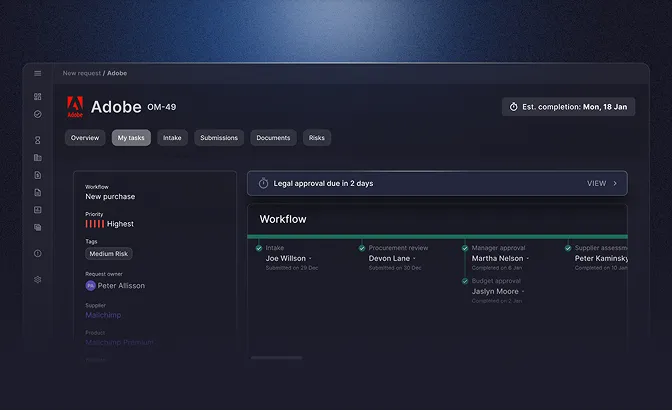
Best for: Procurement, finance, legal and risk teams at mid-market and enterprise companies who want one process across intake, approvals, supplier management, sourcing, risk and renewals without replacing their ERP or procure-to-pay system.
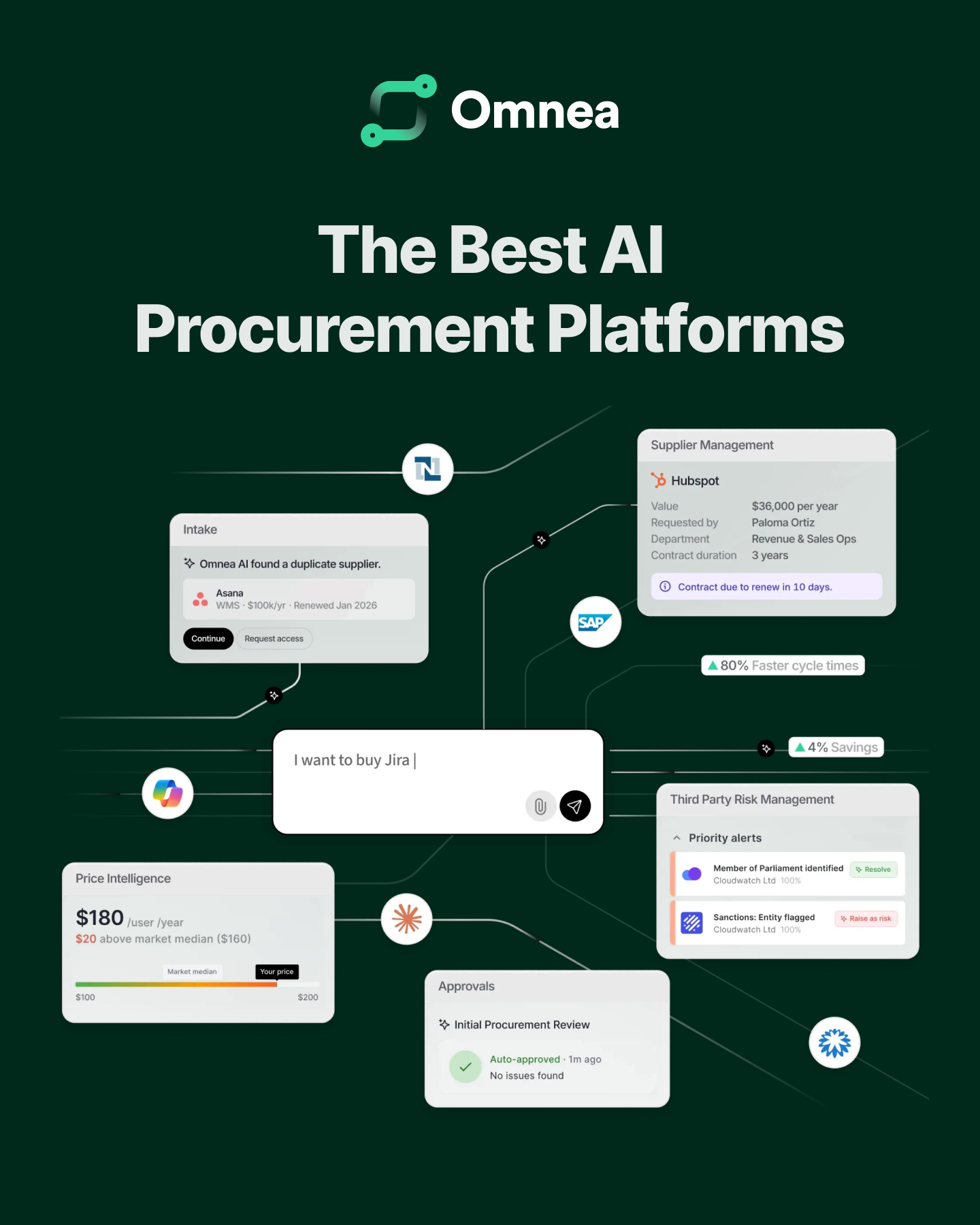
What it does: Omnea is the agentic operating system for procurement and supplier management, covering source-to-contract. Employees raise requests from the web, Slack or Microsoft Teams, or via MCP connected to Claude, ChatGPT, or Copilot. They describe what they need conversationally, and Omnea routes each request through the right approvals, supplier checks, risk assessments and sourcing events based on what is being bought.
The Workflow Builder lets procurement change those rules on a drag-and-drop canvas and push updates to requests already in flight, without an IT ticket. Guided Buying surfaces existing contracts and approved suppliers at the point of request, redirecting duplicate purchases onto agreements you already hold.
Omnea AI learns from the actions your team takes: every approval and rejection, every risk score, every price benchmark feeds the Context Engine that uses reinforcement learning to compound intelligence over time. Generic AI guesses, and one wrong answer is enough for people to stop trusting it. Omnea AI runs on your policies, decisions, exceptions and history, and every action is logged so it can be checked.
That intelligence shows up across the platform: the Approval Agent produces decision-grade recommendations with cited sources and risk flags, AI inherent risk assessment scores and tiers suppliers from their form answers, and the Document Review Agent rates contract clauses against your legal playbook so low-risk paper clears without legal involvement.
Omnea was also the first procurement platform to ship a Model Context Protocol (MCP) server, so teams can query suppliers, purchase orders, spend and upcoming renewals from inside Claude, ChatGPT or Microsoft Copilot, with the same permissions and audit trail as the core platform. MCP works as another way in alongside the web, Slack and Teams apps rather than a replacement for integrations.
Proof points: Across the customer base, an Omnea customer achieves on average 4.2% annual savings on indirect spend and 45% faster cycle times from intake to purchase order, with 96% of spend routed through compliant, pre-approved channels.
The published customer stories put mechanisms behind the averages. The Adecco Group replaced inbox-scattered intake with conversational AI intake in Teams across 22 markets, cutting cycle times by 80% in six months (23.4 days to 4.6) across more than $5bn of indirect spend under management, with EUR 6.24M in avoided spend in the first 90 days. Reach plc cut maverick spend from 30% to 5%, halved manual processing time on risk reviews, and now auto-captures 70% of supplier risks with Omnea AI.
And at TeamViewer, employees started raising requests earlier in the buying process, giving procurement more leverage to negotiate; the team attributed a 4 percentage point year-on-year increase in EBIT to the new intake process.
Omnea is trusted by procurement teams including Albertsons, Adyen, and Spotify, and was named a Gartner Cool Vendor in Sourcing and Procurement Technology.
Where it stops today: Omnea covers intake through purchase order creation in your ERP, then hands off for invoice matching and payment. Omnea starts upstream because that is where the money is committed and where the problems procurement actually complains about begin. By the time an invoice exists, the decision has already been made.
Omnea does not issue vendor cards itself; card programmes run through integrations with the payment stack you already have. It is also built for indirect spend rather than direct materials, so bill-of-materials and MRP-driven ordering stay in the ERP, although many manufacturing-heavy businesses run their indirect spend through Omnea alongside it.
2. Zip: an intake-to-pay suite built before the LLM era
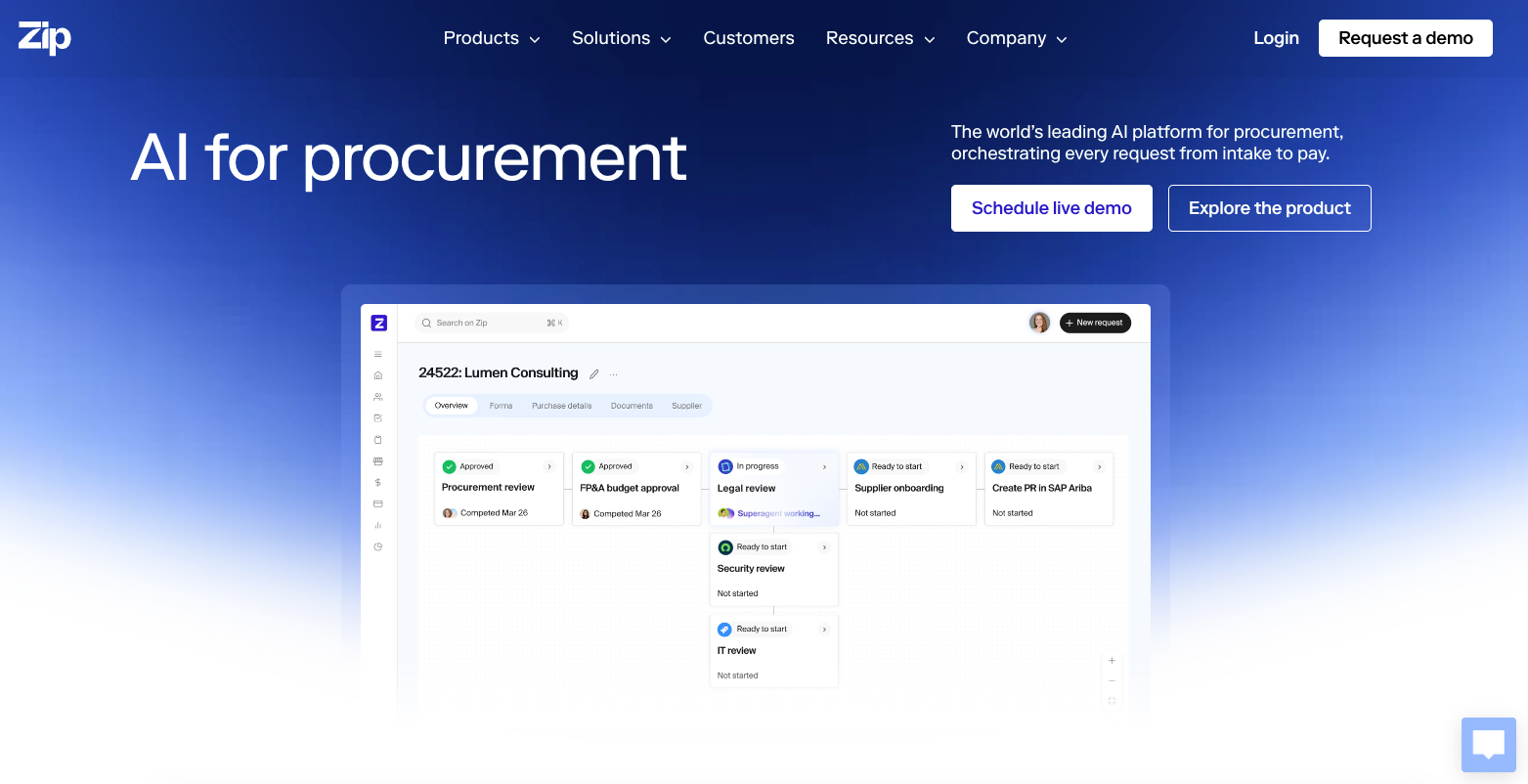
What it does: Zip positions itself as AI for procurement, with a suite running from intake-to-procure through procure-to-pay, global payments, vendor cards and AP automation. The platform grew from intake outward, and its AI agents arrived after their core platform was already cemented, which is the architectural difference this list turns on.
Where it stops: Breadth over depth is the common trade-off. The suite covers a lot of ground, but the depth underneath it is uneven. Risk is where the gap is widest: if continuous supplier monitoring and regulatory reporting under DORA or FCA rules are obligations, test that depth carefullyIntegrations deserve the same scrutiny: ask which systems sync bi-directionally, because one-way connections create reconciliation work downstream.
And the workflow builder is more old school than drag and drop, so changes after go-live tend to route back through Zip rather than your own team. The AI follows the same pattern as the platform: agents retrofitted onto a workflow engine that was already set, rather than an architecture designed around them.
3. ORO Labs: orchestration for complex global enterprise estates
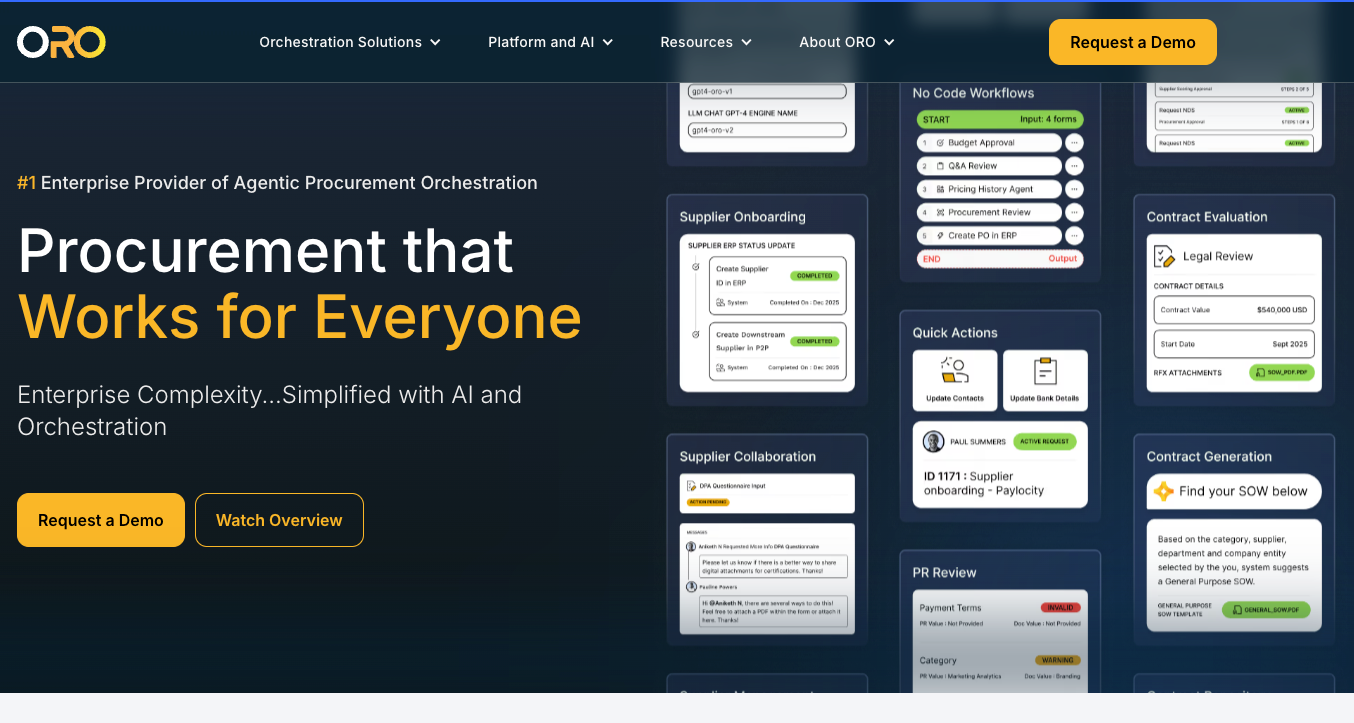
What it does: ORO Labs leads with a complexity-first message, naming the maze of systems and data sources before offering the fix. The founding team came out of SAP and the product carries that Ariba DNA.
Where it stops: The configuration model assumes an enterprise architecture function and a long implementation window. All but the largest enterprise procurement functions will find it heavier than the problem requires.
4. Levelpath: sourcing and user experience first, governance second
What it does: Levelpath leads on experience with "Delightful Procurement. Serious Impact." and the product centres on intake and sourcing, which is where it is strongest. Gartner lists it in the Market Guide for sourcing applications specifically, rather than the broader sourcing and procurement category.
Where it stops: It is a better fit for mid-market teams than for large enterprises, including Qualified and Emerald, because the integration layer is not as robust as required by enterprise. Third-party risk is not a strong suit either, so if continuous supplier monitoring, risk tiering and regulatory reporting are core requirements, test that depth against your actual obligations.
5. Pivot: procurement and payments for smaller, finance-led teams
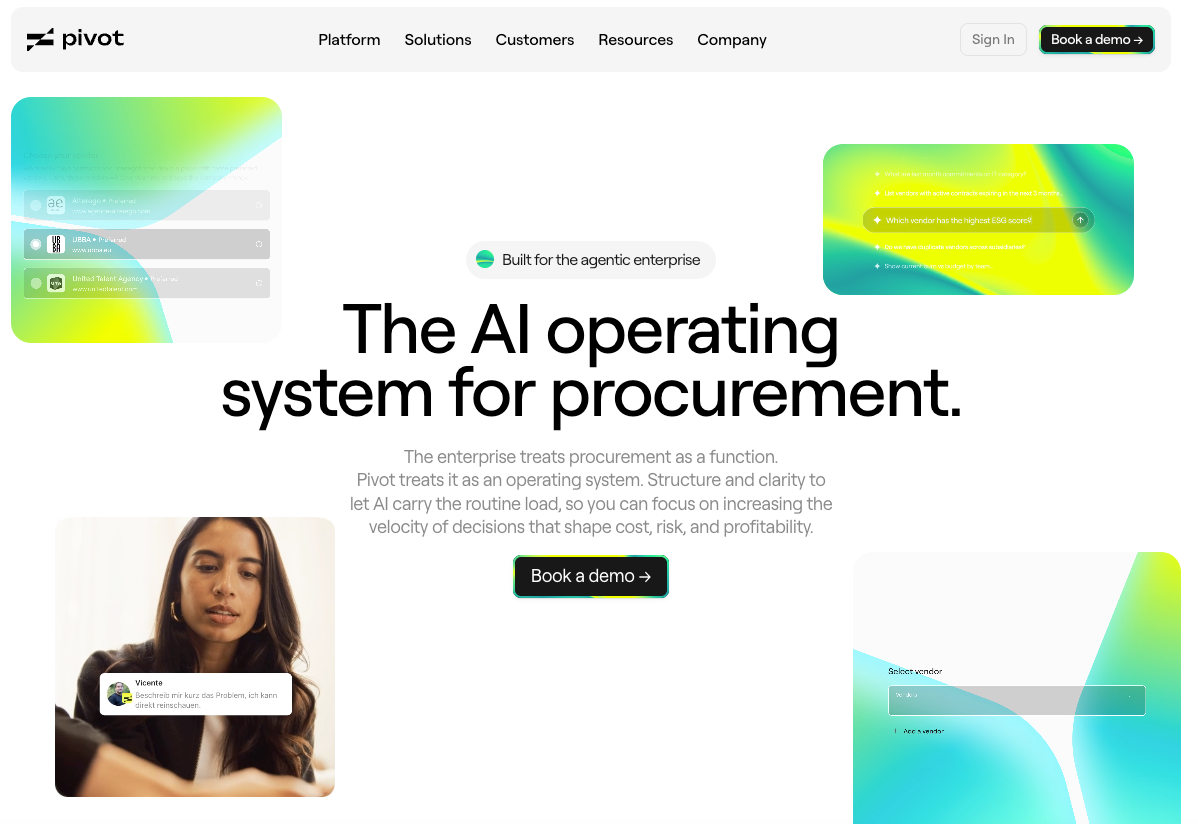
What it does: Pivot is a lightweight option for finance teams with lower spend volumes that mainly need spend requests centralised and renewals tracked, with payments attached. The product spans intake-to-procure, procure-to-pay, AP automation, virtual cards and global vendor payments. If you expect to scale quickly, look for robust foundations: a tool that can support rapid growth in volume, entities and governance.
Where it stops: It is a younger French platform with a domestic SMB customer base, including EcoVardis and Pennylane, and the only vendor not recognized by Gartner as a representative vendor in any procurement category. Third-party risk management is not part of the platform today, so teams with DORA, SOX or vendor due diligence obligations will need a second tool alongside it.
6. Coupa: the legacy source-to-pay suite
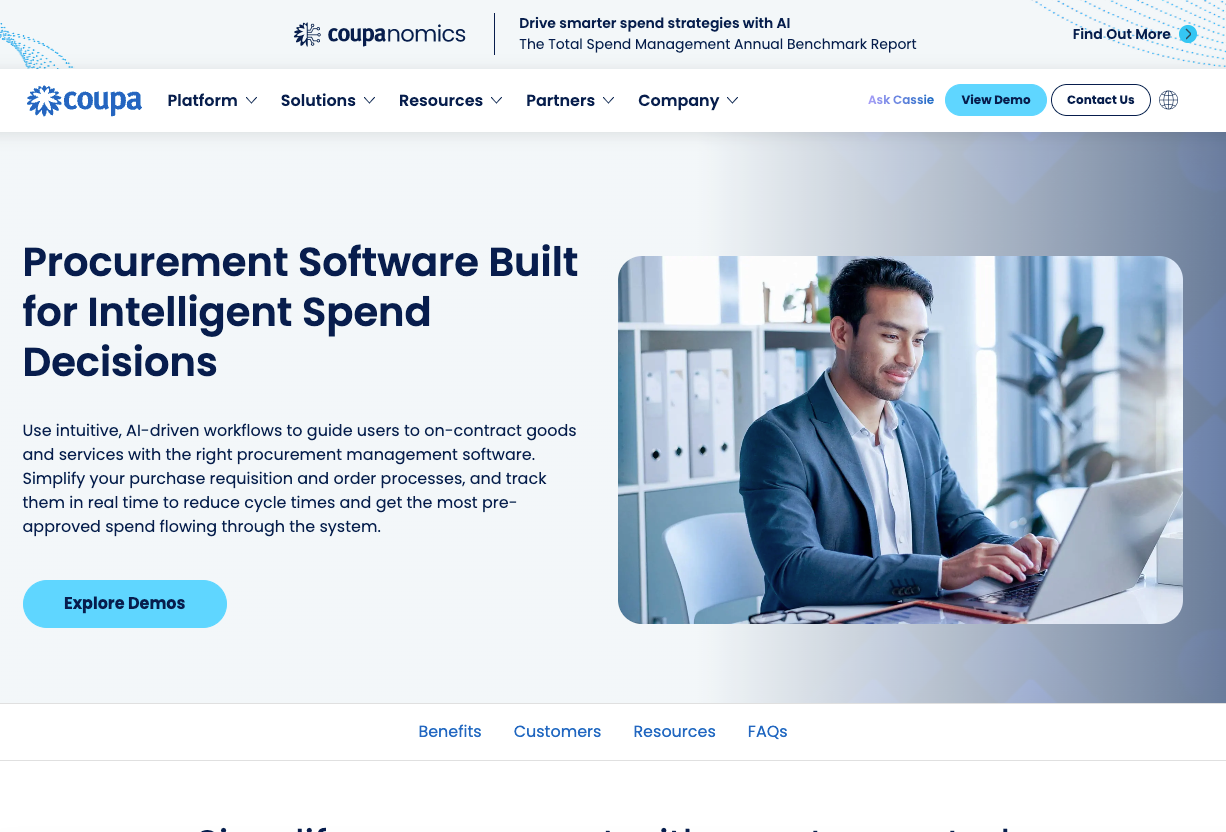
What it does: Coupa is the incumbent, marketing itself as the number one total spend management platform with 20 years of history and $10 trillion in spend data. Its platform spans source-to-contract, procure-to-order, invoice-to-pay, direct spend and supply chain. Former leaders, like Michael van Keulen, have joined AI-native platforms in recent years.
Where it stops: Coupa's strength is the transactional back end. The recurring complaint is the front: implementations run in quarters, the platform requires a dedicated team to maintain, and anyone who needs to use it faces long training before they can.
Employees experience it as heavy, and when the tool is heavy people buy around it, which is how spend leaks out of a system that was bought to control it. The AI, meanwhile, is being retrofitted onto a core that was never designed for it, which is the architectural test this list keeps coming back to.
Many Coupa customers have turned to modern platforms to handle processes from intake to payment, to improve UX and therefore spend visibility.
7. SAP Ariba: procurement inside the SAP estate
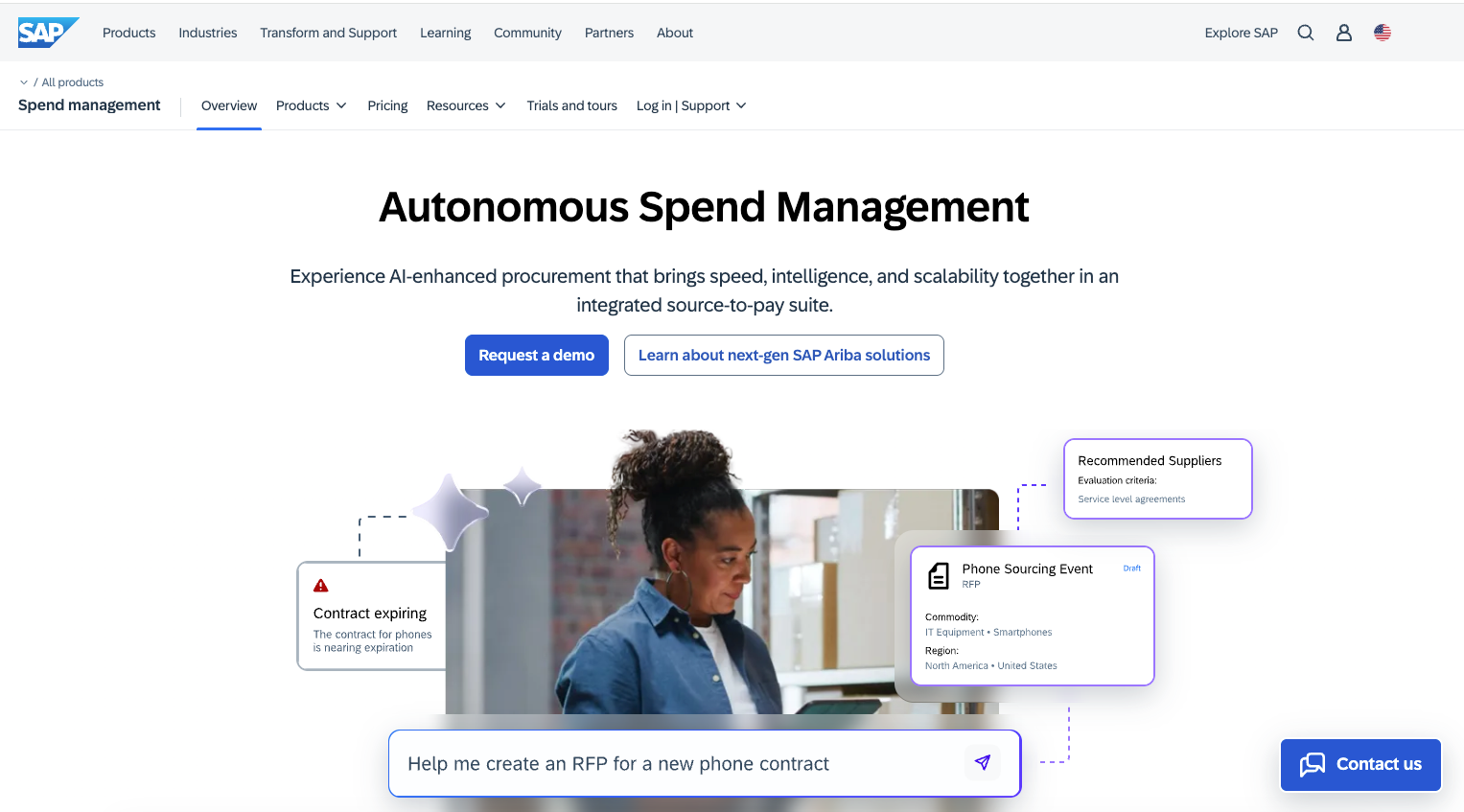
What it does: Ariba covers sourcing, contracts, procurement and supplier management with native SAP integration and access to the Ariba Network, with AI capability being added across the suite.
Where it stops: The architecture is the constraint. The core predates modern AI by two decades, and the pace of change is set by SAP's release cycle. The experience shows its age for everyone who touches it: requesters face long forms in a system they use twice a year, approvers work through dense screens to find what needs their sign-off, and suppliers have another system to learn before they can respond.
Procurement absorbs the difference, manually chasing each of those groups to keep a single purchase moving, which is exactly the coordination work the platform was supposed to remove.
How do you choose between AI procurement tools?
We would recommend starting with the biggest issue or constraint you actually have right now rather than shortlisting the tools with the longest feature list. For example here are some of the most common problems we come across and who you may consider:
If your problem is:
Three questions to take into every demo:
- What can AI leverage? Ask the vendor to show the data the model sees when it makes a recommendation. If the answer is a policy document rather than the live request record, the AI will not get better as you use it. Weak intake produces weak data, and weak data produces weak AI.
- Can we see the audit log? Every AI-influenced decision needs an attributable entry your auditors will accept. Vendors that cannot demonstrate this on a live instance are selling an assistant.
- How can I edit workflows? Ask to watch a change made live in the demo: add an approval step, move a threshold, reroute a request type. If the answer involves a services ticket or a vendor engineer, every future process change inherits that dependency, and your governance changes at the speed of someone else's backlog. The right answer is your own team making the change on a canvas and pushing it to requests already in flight. Our guide to AI in procurement covers what else to test before you sign.
How we chose these platforms
Here are the five criteria we applied consistently across this shortlist:
- The AI does process work, not question answering alone. Summaries and chat interfaces did not qualify on their own.
- Intake is a named capability, not an implied one. The request stage is where compliance is won or lost.
- Verifiable enterprise deployments, with named customers on the record.
- Independent recognition from Gartner, Forrester, Hackett or Spend Matters, or a documented customer base in its place.
- Available in Europe and North America.
FAQs
About Omnea
Omnea is an AI-native platform for procurement orchestration and third‑party risk management.
It helps modern enterprises accelerate decisions, control costs, and embed governance into every purchase by streamlining intake, automating approvals, centralizing supplier data, and continuously managing supplier risk.