Blog
Industry Experts
The stars have aligned for procurement: CIPS CEO Ben Farrell on AI and the rise of the CPO
・ 3
min read

Nick Barker
Marketing Lead

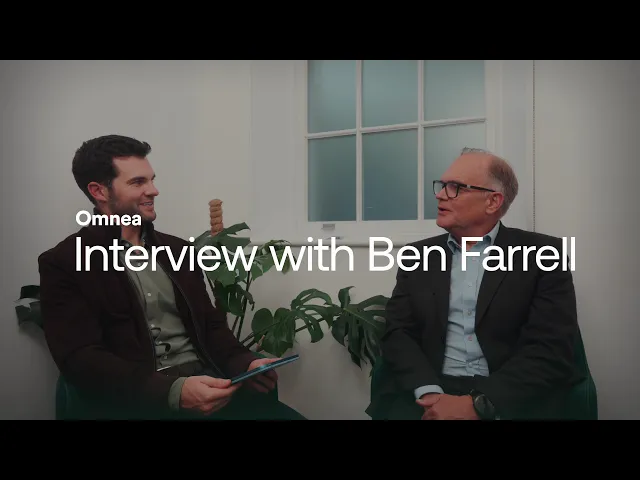
Just before our Annual Summit, Omnea CEO Ben Freeman sat down with Ben Farrell, global CEO of CIPS, for a wide-ranging conversation about where procurement is heading.
Farrell's route into the profession is not the usual one. He spent 23 years in the British Army, commanded the Irish Guards, and earned an MBE at 29 for his work in Kosovo, before moving into business — first at John Lewis, now leading CIPS.
CIPS, the Chartered Institute of Procurement & Supply, is the world's professional body for procurement and supply chain. It sets the global standards that define a procurement career, supports around 70,000 members across more than 150 countries, and is on a mission to professionalise the field and raise its standing inside organizations. That means getting procurement onto the school syllabus, building influence that runs all the way to the CEO's office, and leading what Farrell calls "The Great Conversation" about the future of the profession.
You can watch their full conversation below, or keep scrolling for three key takeaways.
1. AI takes on the work humans should never have been doing
Over the last 18 months, the mood has moved around AI from threat to opportunity. His framing, borrowed from a peer: AI is "doing all the jobs a human should never have done."
Automating the manual work frees procurement people to do what only people can — make the judgement calls, build the relationships, and manage the supplier network that a business actually relies on. Farrell describes a "supply web" rather than a supply chain, and compares the future of sourcing to Netflix. You feed in your requirements, whether cost, timing or sustainability, and the system serves up options, flags when a supplier becomes risky or suboptimal, and points you elsewhere.
In other words, AI won't take procurement jobs; it'll hand people better ones.
2. The stars have aligned for procurement
Farrell's bigger argument is that several forces have lined up at once to push procurement up the agenda:
Geopolitical disruption. Supply shocks and financial uncertainty have grown in frequency and impact year on year since 2008, and boards now turn to procurement and robust third-party risk management for certainty.
The shape of modern business. S&P 500 companies spent almost nothing on third parties in 1950; today, third-party spend sits at around 70%. Organisations have become networks of other organisations, and procurement leaders are the people orchestrating them. It's why running Apple's supply chain set Tim Cook up to run Apple.
Demographics and climate. By 2050 the world will hold 9.7 billion people, 70% of them in cities, all needing water, food, energy and raw materials that have to be sourced — while supply chains account for roughly 90% of global emissions.
These forces were already reshaping the profession, and AI is accelerating every one of them.
3. The CPO is moving from the CFO's shadow to the CEO's side
One consequence runs through all of it: where the chief procurement officer (CPO) sits. For years, CPOs reported to the CFO. That is changing fast. CIPS' data shows 75% of CPOs no longer sit under the finance function, up from 47% in 2024, and the share reporting directly to the CEO has more than doubled in a year, from 14% to 33%.
Farrell thinks this matters because the reporting line shapes the mandate. Under the CFO, procurement gets pulled towards a "slightly binary" brief: hit the savings number. Alongside the CEO, it can help define the business objectives in the first place — the build-or-buy calls, which supplier relationships to invest in, and where to take risk. His advice to procurement leaders is blunt: don't be the recipient of tasks from other people. The role, he argues, increasingly looks more like a chief operating officer's remit.
Farrell's closing advice zooms out beyond procurement, and comes from his army days: "march to the sound of the guns" — go where the action is. Right now, he says, that's procurement.
We're building the agentic operating system for procurement, the platform for the shift this conversation describes — learn more about Omnea AI.





" height="10.661279999999998px" id="LoeK6pYtS" transform="translate(0.27 5.262)" width="3.3432189999999995px"/><path d="M 7.025 0.035 C 6.902 0.019 6.771 0.012 6.64 0.004 C 4.768 -0.073 3.713 1.036 3.343 1.514 C 3.243 1.645 3.197 1.722 3.197 1.722 L 3.197 0.297 L 0 0.297 L 0 10.958 L 3.197 10.958 L 3.343 10.958 C 3.343 9.872 3.343 8.793 3.343 7.707 C 3.343 7.122 3.343 6.536 3.343 5.951 C 3.343 5.227 3.289 4.456 3.651 3.794 C 3.959 3.239 4.514 2.962 5.138 2.962 C 6.987 2.962 7.025 4.633 7.025 4.788 C 7.025 4.795 7.025 4.803 7.025 4.803 L 7.025 11.004 L 10.369 11.004 L 10.369 4.048 C 10.369 1.668 9.159 0.266 7.025 0.035 Z" fill="rgb(115, 112, 108)" height="11.004105999786248px" id="I8ZK_lI2U" transform="translate(5.631 4.996)" width="10.368549999999999px"/><path d="M 1.941 3.882 C 3.013 3.882 3.882 3.013 3.882 1.941 C 3.882 0.869 3.013 0 1.941 0 C 0.869 0 0 0.869 0 1.941 C 0 3.013 0.869 3.882 1.941 3.882 Z" fill="rgb(115, 112, 108)" height="3.8824500000000315px" id="BoA0OppHn" width="3.882450000000003px"/></g></svg>)
" height="12px" id="Gnx304Rz4" transform="translate(0 2.5)" width="16px"/></svg>)