Blog
Our Customers
Pendo builds AI for a living. Here's how they judge it in procurement.
・ 3
min read

Patrick Penzo
Head of Customer Marketing
Pendo’s whole business is helping companies understand and improve how people use software. Their teams use AI like Claude, Gemini, and OpenAI every day to move faster. So when a vendor pitches them an “AI-powered” tool, they’re about the hardest audience you could pick: they already know what real AI looks like, and they can spot a thin wrapper from across the room.
That made Kylee Bloodworth, Pendo’s Senior Director of Global Accounting, exactly the person we wanted to hear from. Kylee runs procurement alongside the rest of her finance function with a team of two senior analysts, covering 800 employees buying across the US, UK, Germany, Israel, India, Japan, and Australia. Her bar for any tool is blunt: if she could get the same result by prompting ChatGPT, it hasn’t earned its place.
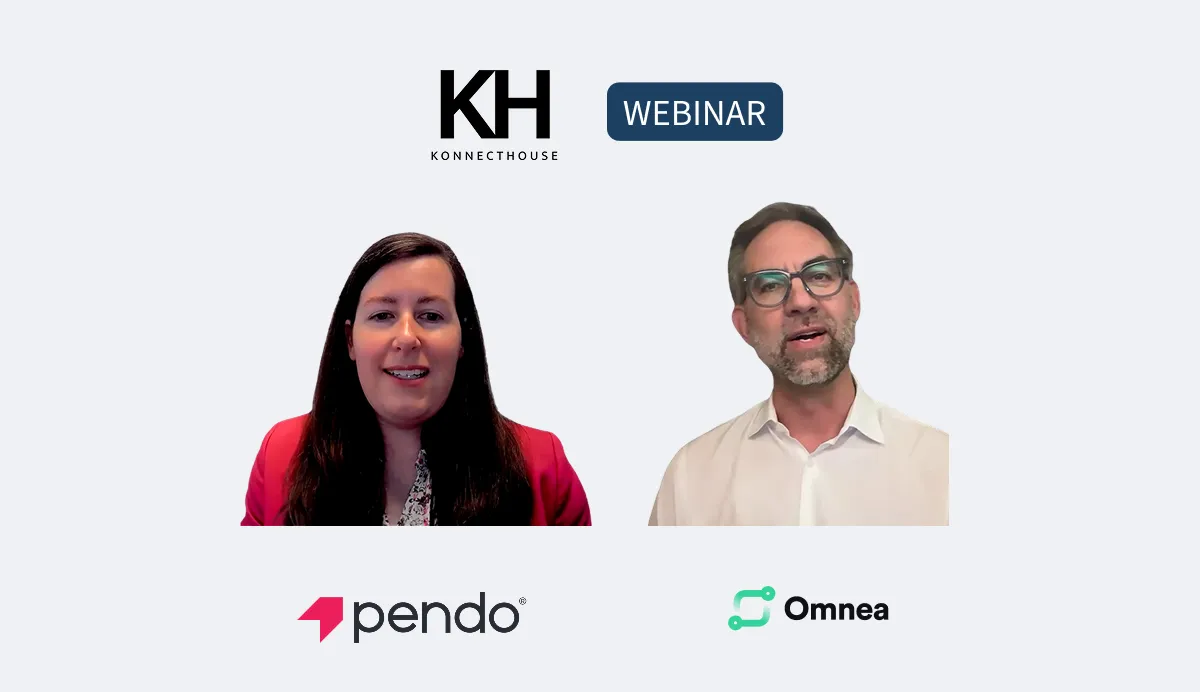
Konnect House hosted a discussion between Kylee and our US General Manager, Arie Barendrecht. The conversation kept circling one gap: the distance between AI as something a tool can technically do, and AI as something that actually changes how a team works day to day. Here are three key takeaways.
Pendo had AI everywhere, except inside the procurement workflow
Before Omnea, Pendo ran procurement on Zip, and the team did use AI — just not where the work lived. A contract would come in, an analyst would copy it out of the system, paste it into ChatGPT or Claude, ask for the risks or a comparison against last year’s terms, export a PDF, then upload that summary somewhere else and manually tell legal to go and read the original in Ironclad.
It worked, in the sense that nobody was reading all 30 pages by hand anymore. But, as Kylee put it, “every team was its own island.” Getting the AI’s output from one desk to the legal or security team meant a steady stream of Slack messages: did you see this document, did you catch the risk score on that one. With the heavier contracts that carry five or six attachments — MSA, NDA, order form, security docs — it was easy for one more PDF in the pile to get missed.
There was a control problem underneath it too. From her finance seat, Kylee knew auditors want to point to one place where everything happens, not a control index that reads “this bit here, that bit there, the third thing somewhere else.” The aha moment was an uncomfortable one: Pendo was already telling other teams across the business to look for AI built into the tools they bought, and procurement, she admitted, “should probably take our own advice.”
The test that cut through the noise: native AI versus a bolt-on
Pendo decided quickly that building their own tool wasn’t worth it. Too many integrations, too many country-specific quirks, and engineers they’d rather keep pointed at Pendo’s own product. That turned the real question into a buying one: with every vendor now claiming to be AI-powered, the job became telling which ones meant it.
Kylee’s answer was a use case, not a feature list. The team anchored every demo on one concrete scenario — a renewal. Hand the tool last year’s contract and this year’s, and a real AI platform should compare them on its own, with no prompting and no exporting, then tell you plainly what changed, what’s new risk, or that the order form is identical to last year’s. After that, it should let you act on the result without sending you off to a second tool.
That last part is where the bolt-ons fell down. Plenty could answer a single question, but taking the next step meant buying another “agent” — and some were sold in bundles of three, which Kylee realised her team could burn through on one simple task. Her rule of thumb: if the AI is really just a pipe to ChatGPT or Gemini, “that’s what my team’s doing already,” and paying again for tokens they already buy made no sense. Two more checks rounded it out. Ask for reference calls with people using the tool daily, because you’ll learn more than any sales demo tells you. And look hard at whether the AI is built into the product or simply sitting beside it.
What changed once the AI lived in the workflow
Pendo went live with Omnea on April 1. Kylee cleared her team’s calendars for launch week and braced for a flood of questions. What she got was crickets. People dropped their documents onto the first screen, the AI read them, and requests went in without any hand-holding.
The bigger shift was what the team stopped doing. The renewal comparison they used to run by hand in ChatGPT now happens inside Omnea: a workflow step reads the old and new contracts, flags a clean no-change renewal onto a fast path, and routes anything complex to the right legal specialist instead of a round-robin. That reframed how Kylee thinks about speed. A low number of days was never the goal. A simple renewal should fly through, and a thorny new AI vendor should take longer and get the scrutiny it deserves.
With the admin handled, procurement moved upstream. The team now pushes people to submit early, even with incomplete documents, so they can get into the negotiation and catch legal issues before anything reaches legal. Managers feel it too: each review opens with an AI summary tuned to the reviewer, so a controller sees savings and a manager sees risk. Kylee’s favourite surprise is managers now pushing back on requests they’d once have waved through — what Arie called productive tension. A team of two spends its time on negotiation and vendor relationships rather than chasing Slack threads. Kylee puts them at 8 out of 10, and climbing.
Looking for AI that earns its place in your procurement workflow? Get in touch.



" height="10.661279999999998px" id="LoeK6pYtS" transform="translate(0.27 5.262)" width="3.3432189999999995px"/><path d="M 7.025 0.035 C 6.902 0.019 6.771 0.012 6.64 0.004 C 4.768 -0.073 3.713 1.036 3.343 1.514 C 3.243 1.645 3.197 1.722 3.197 1.722 L 3.197 0.297 L 0 0.297 L 0 10.958 L 3.197 10.958 L 3.343 10.958 C 3.343 9.872 3.343 8.793 3.343 7.707 C 3.343 7.122 3.343 6.536 3.343 5.951 C 3.343 5.227 3.289 4.456 3.651 3.794 C 3.959 3.239 4.514 2.962 5.138 2.962 C 6.987 2.962 7.025 4.633 7.025 4.788 C 7.025 4.795 7.025 4.803 7.025 4.803 L 7.025 11.004 L 10.369 11.004 L 10.369 4.048 C 10.369 1.668 9.159 0.266 7.025 0.035 Z" fill="rgb(115, 112, 108)" height="11.004105999786248px" id="I8ZK_lI2U" transform="translate(5.631 4.996)" width="10.368549999999999px"/><path d="M 1.941 3.882 C 3.013 3.882 3.882 3.013 3.882 1.941 C 3.882 0.869 3.013 0 1.941 0 C 0.869 0 0 0.869 0 1.941 C 0 3.013 0.869 3.882 1.941 3.882 Z" fill="rgb(115, 112, 108)" height="3.8824500000000315px" id="BoA0OppHn" width="3.882450000000003px"/></g></svg>)
" height="12px" id="Gnx304Rz4" transform="translate(0 2.5)" width="16px"/></svg>)