Blog
Our Customers
Scaling procurement with tech, not headcount: key takeaways from Thumbtack’s James Rafferty
・ 4
min read

Nick Barker
Marketing Lead
Procurement transformation is in the spotlight, but the winners won’t be the teams with the most tools. They’ll be the teams that make procurement genuinely easy for the business to engage with.
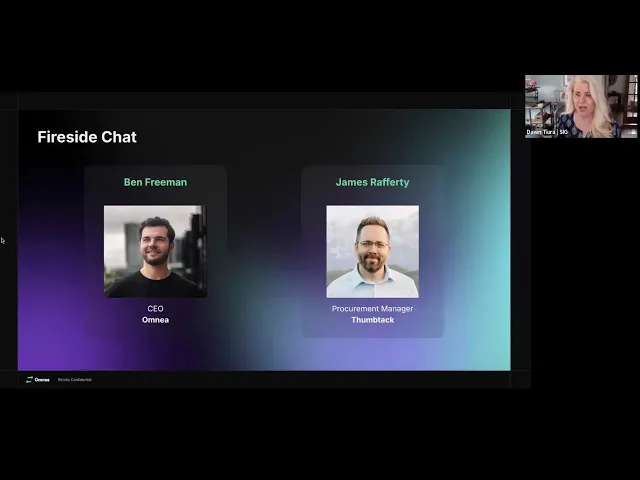
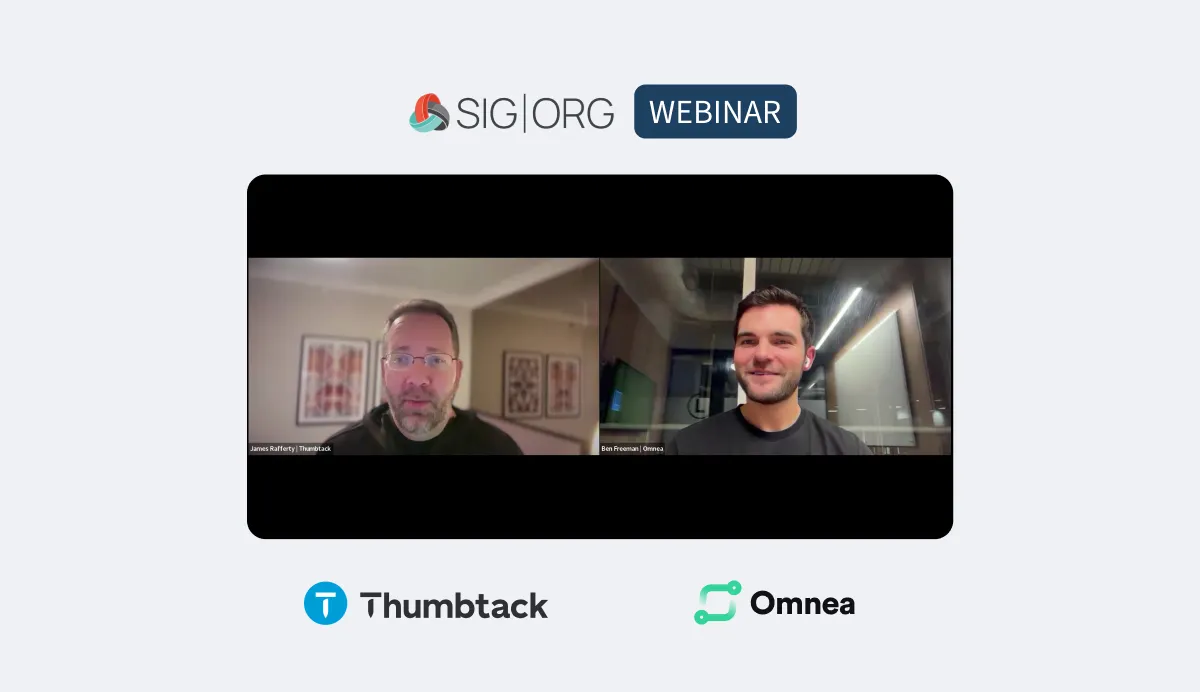
In our recent SIG webinar fireside chat, Ben Freeman sat down with James Rafferty, Head of Procurement at Thumbtack, to talk about building procurement from the ground up, scaling a lean team, and why intake and orchestration is becoming the “front door” that modern procurement needs.
Thumbtack is a fast-moving home services marketplace with around 1,200 employees, and James leads their three-person procurement team. The conversation took a practical look at what it takes to move from ad hoc requests to a consistent, scalable process that people actually want to use.
If you’re planning transformation and any of these pains sound familiar, this session offers a practical perspective:
You have a P2P system in place, but the requester experience still feels heavy
Requests bounce between systems (P2P, CLM, security, legal), causing friction and rework
You’re trying to scale impact without immediately scaling headcount
You want to build processes that are strong enough to support AI later (instead of trying to automate chaos)
If you can’t watch the full recording, you’ll find key learnings from the session below.
UX is king
James has spent most of his career in large, complex organisations where change is slow and process is heavy. At Thumbtack, he had the opportunity to build procurement differently: agile, outcome-driven, and focused on what stakeholders actually experience.
His north star is simple: reduce the time non-procurement teams spend doing procurement. As he put it, Thumbtack’s CEO wants people spending “less work on work”, and procurement is a perfect example.
A few practical ideas stood out:
Design around the requester, not the function. James anchored his evaluation on one question: what is the requester experience going to be?
Avoid one-size-fits-all workflows. A software evaluation is not the same as a hotel contract — so the intake journey shouldn’t be the same either.
Use feedback as a feature. James shared he’s had a “100% valuable feedback rate”. The goal isn’t perfection on day one; it’s a fast feedback loop and continuous refinement.
The takeaway: UX isn’t fluff. In procurement, user experience is the difference between a process that creates leverage and one that inspires workarounds.
Transformation is in the spotlight
To ground the conversation, we ran a quick poll to understand where attendees are today. A few results jumped out:
24% said they’re already using an intake and orchestration provider
66% have a P2P system in place
59% said they’re embarking on a procurement transformation in 2026
What this tells us: P2Ps are not living up to expectations, and leaders are looking for a another way of interfacing with the business. Typically we see this translate to the lack of a simple, intelligent intake that routes requests through the right steps, in the right order, with the right stakeholders without adding friction.
Intake and orchestration unlocks scale and lays the foundations for AI
James runs a lean team and wants to keep it that way, choosing first to scale capacity with technology, then with headcount only when roles can be focused on high-value work. The goal is to move procurement away from “traffic cop at a busy intersection” and toward strategic partnership.
That’s where intake and orchestration plays a different role than traditional systems:
It puts the right activity in the right sequence
It brings the right people in at the right time
It eliminates manual chasing and data entry
It creates governed, repeatable process
And crucially, it sets you up for AI in a way that actually works. James was direct on this point: you can’t layer AI on top of an immature process and expect magic: you can’t automate chaos.
With solid orchestration in place, AI becomes an accelerant of good process:
Making intake easier (e.g., smarter capture, document handling)
Identifying bottlenecks and friction points in workflows
Improving process quality over time using real usage data
Put simply, AI is downstream of good process. Intake and orchestration helps you build the process foundation that makes AI valuable.
If you’re embarking on a transformation journey and would like to hear more about Omnea, please get in touch.



" height="10.661279999999998px" id="LoeK6pYtS" transform="translate(0.27 5.262)" width="3.3432189999999995px"/><path d="M 7.025 0.035 C 6.902 0.019 6.771 0.012 6.64 0.004 C 4.768 -0.073 3.713 1.036 3.343 1.514 C 3.243 1.645 3.197 1.722 3.197 1.722 L 3.197 0.297 L 0 0.297 L 0 10.958 L 3.197 10.958 L 3.343 10.958 C 3.343 9.872 3.343 8.793 3.343 7.707 C 3.343 7.122 3.343 6.536 3.343 5.951 C 3.343 5.227 3.289 4.456 3.651 3.794 C 3.959 3.239 4.514 2.962 5.138 2.962 C 6.987 2.962 7.025 4.633 7.025 4.788 C 7.025 4.795 7.025 4.803 7.025 4.803 L 7.025 11.004 L 10.369 11.004 L 10.369 4.048 C 10.369 1.668 9.159 0.266 7.025 0.035 Z" fill="rgb(115, 112, 108)" height="11.004105999786248px" id="I8ZK_lI2U" transform="translate(5.631 4.996)" width="10.368549999999999px"/><path d="M 1.941 3.882 C 3.013 3.882 3.882 3.013 3.882 1.941 C 3.882 0.869 3.013 0 1.941 0 C 0.869 0 0 0.869 0 1.941 C 0 3.013 0.869 3.882 1.941 3.882 Z" fill="rgb(115, 112, 108)" height="3.8824500000000315px" id="BoA0OppHn" width="3.882450000000003px"/></g></svg>)
" height="12px" id="Gnx304Rz4" transform="translate(0 2.5)" width="16px"/></svg>)