Blog
Industry Experts
Build vs. buy in procurement AI: buy infrastructure, build advantage
・ 10
min read

Rob Fagg
VP Product
We are living through a generational technological shift. The gap between what a procurement team of 10 could do five years ago and what it can do today is astronomical. Workflows that required three people and two weeks now take minutes. Supplier risk assessments that were quarterly are becoming continuous. Intelligence that used to sit in an analyst’s head is being codified, surfaced, and acted on automatically.
That equates to more strategic impact. More direct margin impact. More rigorous risk control. And the potential for AI is accelerating every day! The right systems and infrastructure are critical for AI to be effective, and for procurement teams to drive value.
Most teams will consider the question of whether they should build or buy these systems, either to exert control over their exact specifications, or reduce costs. But the mistake most teams make is treating this question as binary. In doing so they miss a third-option, which is what most high-performing procurement teams are actually choosing.
The decision is not binary
When procurement leaders talk about “build vs. buy,” they’re usually imagining two black-and-white options: a full bespoke build by an engineering team, or a rigid, out-of-the-box platform that may or may not fit the business.
Both options have real problems.
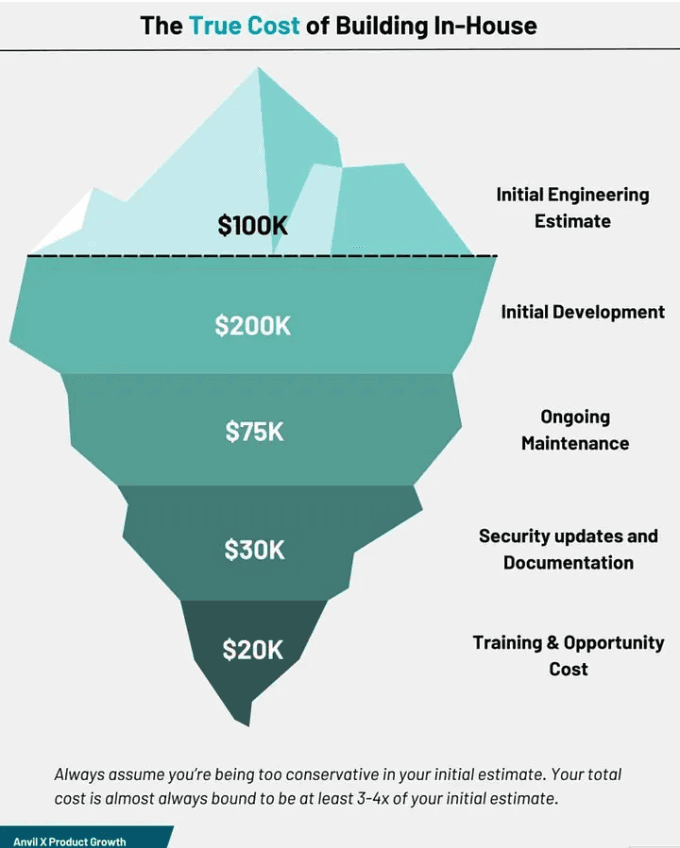
Full custom builds, whether done internally or by a consultancy, look affordable at the start and expensive by year 2 and 3. They necessitate includes engineering salaries, cloud infrastructure, security testing, ongoing compliance reviews, and the opportunity cost of everything else those engineers aren’t building. Most system knowledge will likely live with 1–2 people. When one of them leaves, systems get left in limbo, and can require a rebuild to escape.
There’s a useful historical parallel here. SaaS was invented precisely to escape the maintenance burden of on-premise systems — the patching cycles, the single-tenant infrastructure, the institutional knowledge locked in a few engineers. Building your own AI platform in 2026 risks recreating those problems.
Rigid platform buys carry a different risk. The major legacy suites, built in the pre-GPT era, were designed as systems of record. AI was added to those architectures later, as an additive layer rather than a native capability. Last year, SAP Ariba announced they were rewriting their platform, rather than continue to build on their existing platform. Their decision to abandon 30 years of engineering shows it’s not possible to retrofit legacy systems to perform like AI-native counterparts.
The risk isn’t limited to legacy suites. Point solutions — standalone tools built for a single function, with AI bolted on afterwards — face the same structural problem. The category is consolidating. What’s winning is verticalized workflow platforms where AI is embedded natively, not attached. A standalone AI tool for contract review, or a separate AI tool for supplier risk, creates the same fragmentation problem that procurement software was supposed to solve. The question isn’t whether a point solution does its single job well. It’s whether you want to manage six of them.
Between full custom and fully rigid sits the option most organisations overlook: a specialist platform purpose-built for procurement, with the configurability to be shaped around your organisation’s specific context — without your team becoming a software company.
Buy to Build: the approach that changes the equation
“Buy to Build” is the model that resolves the tension most organisations get stuck in.
The idea is straightforward. You buy a specialist platform as your foundation: one with enterprise-grade security, compliance, and AI infrastructure managed by the vendor. But you build on top of it: configuring it to your processes, your policies, your supplier relationships, your risk appetite, and your workflows. You get the infrastructure off your plate while retaining the customisation that makes the system actually work for your organisation.
This is not a compromise between build and buy. It’s a different decision category.
The distinction matters because most of the cost in a full custom build isn’t in the interesting parts. It’s in the maintenance, the security patching, the model deprecation cycles, the compliance recertification, the API upkeep as your other systems change. None of that creates a competitive advantage; it just keeps the lights on.
There’s a second cost that gets underestimated: explainability. If you plug an LLM directly into your ERP or your contract database, you get output — but you don’t necessarily get a traceable chain of reasoning. For enterprise procurement functions, especially in regulated industries, that’s not a detail. Compliance teams, CFOs, and legal functions need to be able to audit decisions: why was this supplier flagged? Why did this approval route? Why did this contract clause trigger a review? A black-box AI that produces the right answer but can’t explain it won’t pass enterprise governance. Buy-to-Build on a purpose-built procurement platform means AI that is auditable by design, not as an afterthought.
The build-it-yourself path forces a choice between speed and control. Fast automation that can’t be explained, or explainable processes that are too slow to be useful. If teams have to choose between speed and control, they lose. They need a system that gives them both. That’s the Buy to Build design principle. The platform infrastructure gives you the speed. The configuration layer gives you control. You don’t have to pick.
Buy-to-build means a vendor permanently takes on that burden. Your team focuses on the configuration that creates real value: the workflows that reflect how your business actually works, the policies that encode your risk decisions, and the integrations that connect your procurement process to the rest of the business.
What this looks like in practice
Omnea is built on this model. The platform handles all AI infrastructure, model management, security, compliance, continuous improvement, while giving procurement teams the tools to configure it completely for their context. A few concrete examples of what that configurability looks like:
Custom workflows: Procurement teams build approval logic specific to their organisation — not generic approval chains, but workflows that reflect actual business rules. When a software request comes in over a certain threshold, route it to security first, then legal, then finance — running in parallel where possible. When a supplier is flagged as high-risk in a specific geography, automatically add a compliance review step. The configuration is no-code, done on a visual canvas by the procurement team without engineering involvement. When your business changes, e.g. a new regulatory requirement, a post-acquisition integration, a shift in risk appetite, procurement updates the workflow, not the code.

Policy configuration: The policies that govern how intake requests are handled, what risk questions get triggered, and what thresholds require escalation are set by the procurement team, not baked into the product by the vendor. That extends to supplier risk tiers: which vendors require annual due diligence, which are reviewed on a rolling schedule, and which trigger automatic re-assessment when external risk data changes. The system continuously enforces your risk appetite, not just at onboarding and not only when someone runs a manual review.
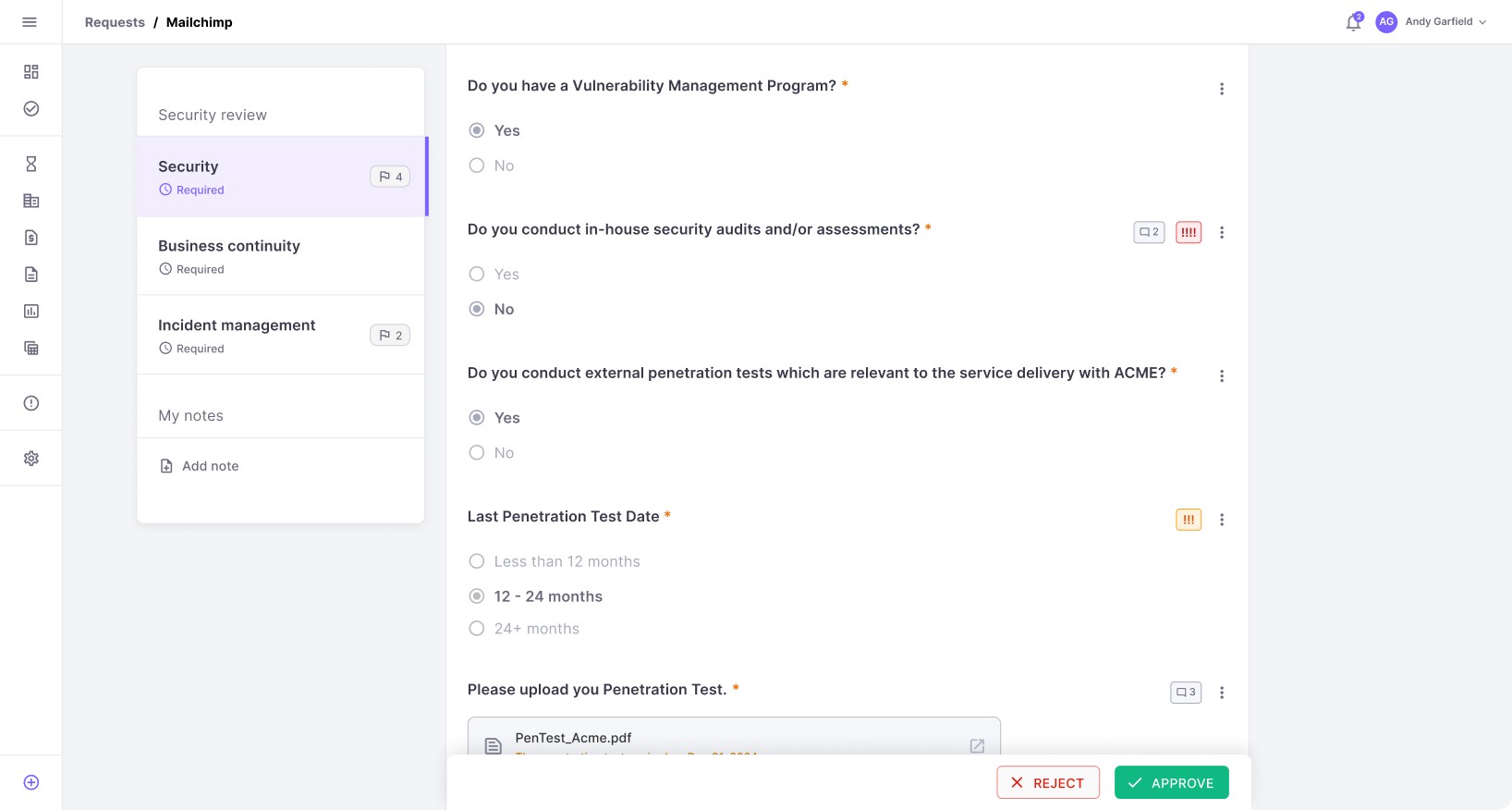
Deep bidirectional integrations: A typical procurement workflow touches six to eight systems: ERP, CLM, HRIS, ticketing, eSign, TPRM data providers, and increasingly communications platforms like Teams or Slack. In a custom build, each of those integrations needs to be architected, built, tested, maintained, and updated whenever one of those systems changes or upgrades. That’s a significant ongoing engineering commitment that tends to get underestimated. With Omnea, these integrations are pre-built and bidirectional: supplier records updated in your ERP are reflected immediately in procurement workflows, not synchronised overnight. The question isn’t whether a bespoke build can connect to Workday. It’s who maintains that connection in year three, and whether that’s the best use of your engineering team.
The point is not that Omnea is 100% pre-configured. It’s that the parts you’d spend 18-24 months building from scratch, the infrastructure, the security layer, and the base workflows come production-ready. The AI capability, i.e., the agents, automation, and model management, is embedded throughout. You decide where to deploy it and at what pace. The parts that are specific to your organisation, the policies, the logic, the integration points, the risk rules, are yours to configure and own.
That’s Buy to Build. You’re not choosing between control and speed, but you’re getting both.
The real build vs. buy checklist
Before any organisation commits to a custom build, be it in-house or via consultancy, six questions should be answered honestly:
Can your procurement team change a workflow without raising a ticket? The real test of control isn’t whether you built the system. It’s whether the people who use it day-to-day can adapt it as the business changes. When a regulatory requirement lands, a risk threshold shifts, or a post-acquisition integration is needed — how long before that’s live? If the answer involves a sprint cycle and a developer dependency, procurement doesn’t own the process.
What’s your plan for model deprecation? The LLM you build on today will not be the right choice in two years. Every model update, API change, or architecture shift requires active migration, regression testing, and performance validation. This is a permanent engineering obligation, not a launch consideration. Who handles it, and at what cadence?
What does the three-year business case actually look like? Not the build estimate. The operating cost: fully-loaded engineering salaries, cloud infrastructure, compliance recertification, integration upkeep as your other systems evolve, and the premium for retaining AI-specific engineering talent in a market where demand outstrips supply by more than three to one.
Who carries the institutional knowledge, and what’s it worth when they leave? Home-built systems are only as robust as the people who built them. When they leave, the logic, the workarounds, and the institutional memory leave with them.
Who identifies tomorrow’s use cases? A specialist vendor with deployments across hundreds of customers sees patterns your team won’t. How do you replicate that?
What isn’t getting built instead? Every month of engineering capacity on internal tooling is a month not spent on differentiated product work.
If the answers to more than two of these are uncomfortable, the build case is weaker than it appeared.
In summary
The best procurement teams are not choosing between building and buying. They are choosing platforms that let them do both: buy the infrastructure, build the configuration, and avoid taking on the burden of maintaining a software product internally.
The real cost of building is not just the initial implementation. It is the ongoing engineering time, admin overhead, model maintenance, integration upkeep, and governance work required to keep the system effective. Over time, that turns a procurement transformation into an internal product roadmap. We work with several of the most engineering focused businesses on the planet including Cohere, Spotify, and MongoDB. None of them have chosen to spend their time and resources building procurement systems. Instead Omnea provides the foundation and we together configure it around their unique workflows, policies, supplier base, and risk models.
When such a foundation is in place, procurement teams can spend less time shepherding process and more time driving outcomes: better supplier decisions, stronger risk control, faster execution, and more leverage in negotiation. Building your own system may look like control on day one. In practice, it often creates a new layer of admin and upkeep. The goal is not to give procurement another system to run. It is to give them a system that lets them do their best work.
If you’re thinking about transforming your procurement systems and would like to hear more about Omnea, please get in touch.





" height="10.661279999999998px" id="LoeK6pYtS" transform="translate(0.27 5.262)" width="3.3432189999999995px"/><path d="M 7.025 0.035 C 6.902 0.019 6.771 0.012 6.64 0.004 C 4.768 -0.073 3.713 1.036 3.343 1.514 C 3.243 1.645 3.197 1.722 3.197 1.722 L 3.197 0.297 L 0 0.297 L 0 10.958 L 3.197 10.958 L 3.343 10.958 C 3.343 9.872 3.343 8.793 3.343 7.707 C 3.343 7.122 3.343 6.536 3.343 5.951 C 3.343 5.227 3.289 4.456 3.651 3.794 C 3.959 3.239 4.514 2.962 5.138 2.962 C 6.987 2.962 7.025 4.633 7.025 4.788 C 7.025 4.795 7.025 4.803 7.025 4.803 L 7.025 11.004 L 10.369 11.004 L 10.369 4.048 C 10.369 1.668 9.159 0.266 7.025 0.035 Z" fill="rgb(115, 112, 108)" height="11.004105999786248px" id="I8ZK_lI2U" transform="translate(5.631 4.996)" width="10.368549999999999px"/><path d="M 1.941 3.882 C 3.013 3.882 3.882 3.013 3.882 1.941 C 3.882 0.869 3.013 0 1.941 0 C 0.869 0 0 0.869 0 1.941 C 0 3.013 0.869 3.882 1.941 3.882 Z" fill="rgb(115, 112, 108)" height="3.8824500000000315px" id="BoA0OppHn" width="3.882450000000003px"/></g></svg>)
" height="12px" id="Gnx304Rz4" transform="translate(0 2.5)" width="16px"/></svg>)