

Most “how we hire” posts are dressed-up job ads. They say things like “we move fast” and “low ego” and “you’ll have real ownership” and they tell you almost nothing about what it’s actually like to work somewhere.
I’m Brett, Chief of Staff across R&D at Omnea. I’m involved in almost every engineering hire we make — running interviews, calibrating assessments, and thinking hard about what “good” looks like for us. We’re a team of around ~40 engineers today, and we’re planning to roughly double by year end. That’s a lot of hiring, and it means we’ve had to get clear on what we’re actually looking for.
So this is my attempt to give you something genuinely useful: an honest view of what we value, how we work, and what our process actually involves.
What we’re building and why it matters
Omnea is an AI Supplier Relationship Manager. In plain terms: the software that helps companies like Monzo, Adyen, MongoDB, HubSpot, and Spotify manage their suppliers, control their spend, and make better purchasing decisions.
Procurement has been badly underserved by software for a long time. Most tools in this space are clunky, approval-heavy, and built around compliance rather than actually helping people make good decisions. We’re rebuilding that from the ground up with an AI-native product — which means there are interesting engineering problems everywhere.
You’re not building CRUD. You’re building systems that need to reason over messy, incomplete supplier data, surface the right insight at the right moment, and handle the complexity of how real companies actually buy things. The AI isn’t a feature layered on top — it’s how we think about the whole product.
In practice, that means problems like:
Inferring structured supplier data from inconsistent contracts, invoices, and emails
Designing systems that surface the right recommendation at the exact moment a purchasing decision is being made
Handling approval workflows that vary wildly between companies without turning the product into a configuration nightmare
Our stack is TypeScript throughout — React on the frontend, Node on the backend, running on AWS serverless. But the stack isn’t the interesting part.
What we look for
The team today includes engineers who’ve previously worked at companies like Meta, Monzo, Scale AI, Tractable, Cazoo, Hook, Orbital, and Primer.ai.
We hold a high bar — technically and culturally. We believe strongly in talent density, and it’s something we’re intentional about protecting as we grow. Every hire either raises or lowers the average, and we take that seriously.
With that said, we don’t hire to a checklist. After running a lot of interviews, there are a few things that consistently separate the engineers who do well here.
Ownership, not execution
The way our teams are structured, you’re not picking tickets off a backlog. You’re expected to understand why something matters, push back if you think we’re solving the wrong problem, and see things through from early idea to production.
You will be in the room when the product direction gets set. Some people find that energising. Others prefer to start from a well-defined brief — clear requirements, scoped work, focused execution. If that’s always required for you to do your best work, Omnea probably isn’t the right fit. If you gravitate towards shaping the plan and deciding what gets built in the first place, you’ll feel at home here.
Product-mindedness
This is the thing we care about most, and also the hardest to assess in an interview. The engineers who have the biggest impact here aren’t just technically strong — they think about the person on the other side of what they’re building. They ask “what are we actually trying to achieve?” before they start. They notice when something is technically correct, but would be confusing to use in practice.
You’re building for procurement teams at companies like Monzo and Spotify. Our customers are product leaders in their own right, and know when something doesn’t work.
Comfort with modern tooling — including AI
The way engineers work is changing fast, and we want people who are actively pushing forward modern AI tooling rather than resistant to it.
We actively encourage people to use AI tools in their workflow. Not as a shortcut, and not instead of thinking carefully — but because the strongest engineers right now are using these tools to move faster, explore solutions more quickly, and spend their time on the problems that actually require careful thought. We’re building an AI-native product. It helps when the team thinks that way too.
Being easy to work with
This sounds vague, but it matters practically. We move fast and make a lot of decisions, often with incomplete information. What makes that work is people who communicate clearly, share context generously, and care more about getting to the right answer than about being right.
We’re not looking for people who just go along with things — we want people who push back when they disagree. The best people do this in a way that doesn’t create friction or barriers, but helps those around them make smarter, better decisions.
A track record of achievement
Beyond the day-to-day, we tend to look for people who have consistently pushed themselves. That often shows up as a strong academic background, but it doesn’t have to — we’re equally interested in people who’ve built things at early-stage startups, competed seriously in sport, or pursued something difficult outside of work and seen it through. What matters is that there’s evidence of drive and high standards somewhere in your history.
We also find that people who’ve worked in fast-paced, early-stage VC-backed companies tend to hit the ground running here. Not because that background is a requirement, but because the context is familiar — moving quickly with limited information, wearing multiple hats, and caring deeply about outcomes rather than process.
How we work
All our engineering and product teams are based in London. We’re in the office Tuesday to Thursday, with Monday and Friday flexible.
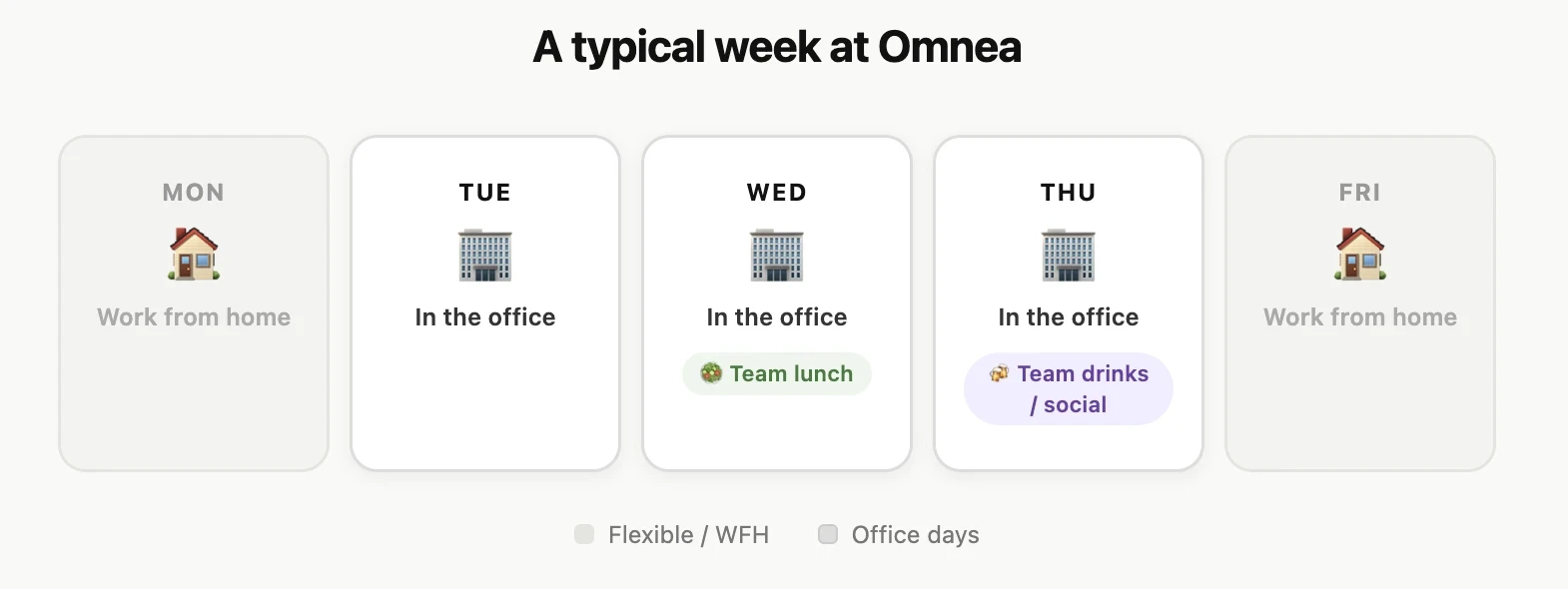
This isn’t policy for the sake of it. We’ve found that the in-person time makes a big difference to how quickly we move and how well we work through complex problems together. We’ve found that the in-person time makes a big difference to how quickly we move and how well we work through complex problems together. Our eight engineering teams — each with a product manager, team lead, and designer — all sit together as a unit. You’re not separated from the people you’re building with day to day.
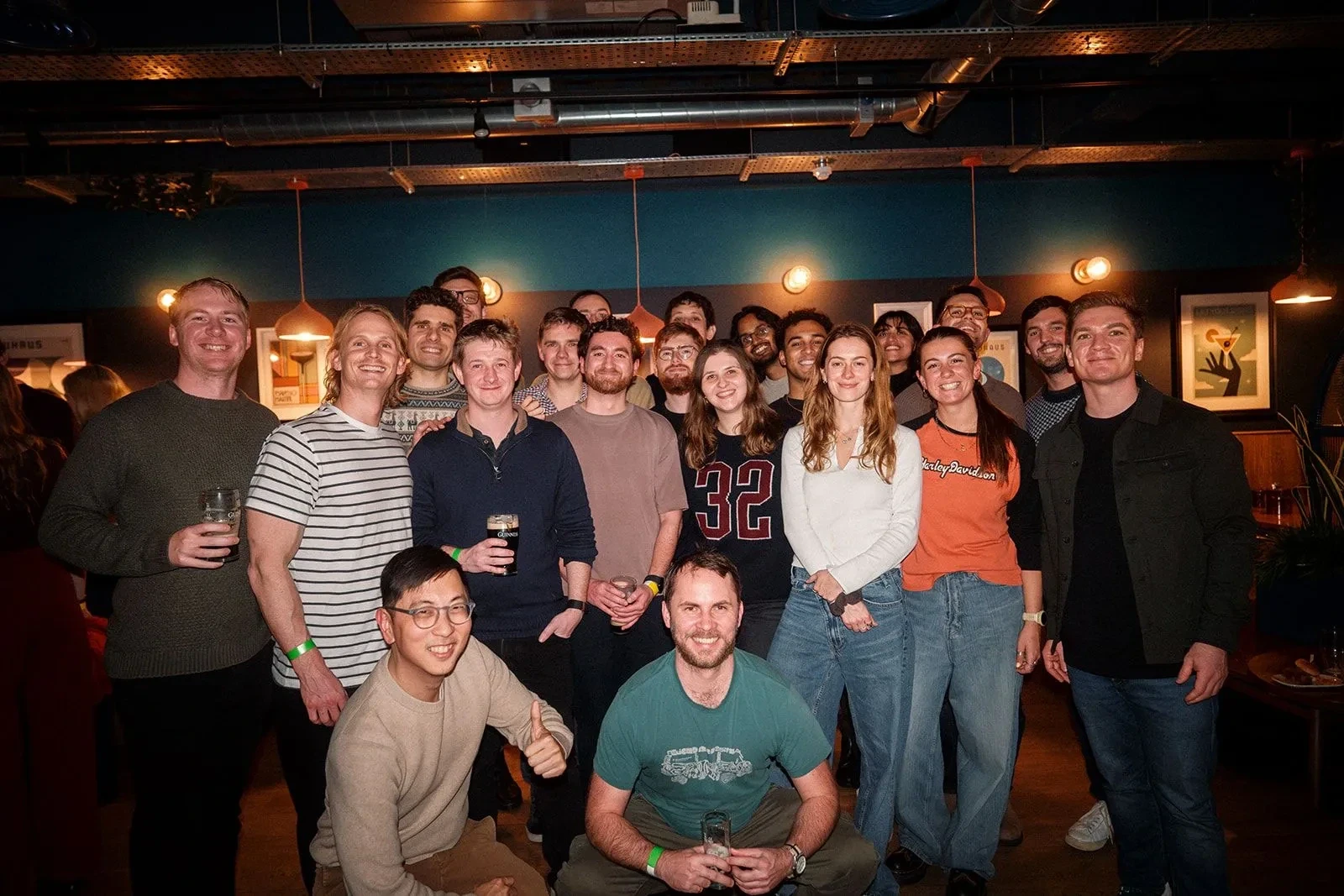
We do a company-wide lunch every Wednesday, regular team socials, and a monthly company-wide event.
One thing I’d say honestly: we are a Series B company, and some things that are polished at bigger companies are still being figured out here. What that also means is that the work you do is visible, your influence on how things get built is real, and the decisions you make actually matter. If you’ve spent time at a company where you felt several steps removed from anything meaningful, this will feel different.
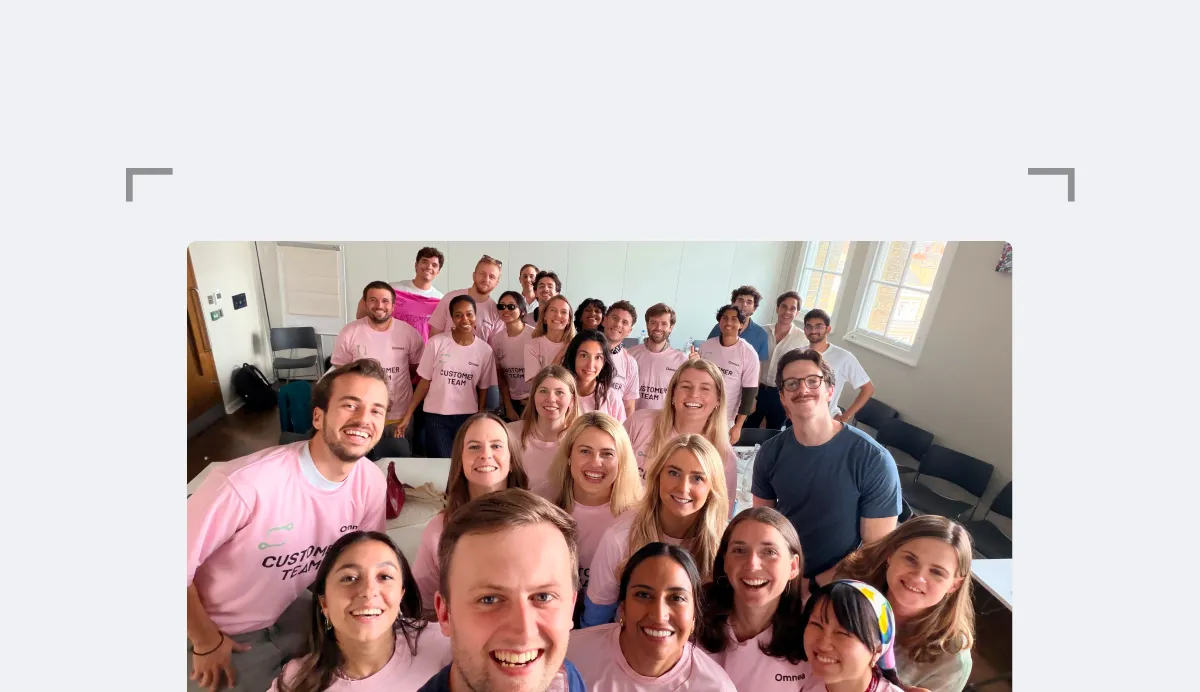
It’s a high-performance environment — we hold a high bar, we move quickly, and the problems are genuinely hard. But it’s also a team people actually enjoy being part of.
To make that a bit more concrete, a typical week might involve:
Working directly with a customer to understand a broken procurement workflow
Designing and shipping a feature end-to-end
Debating product direction with engineers and product in the same room
Using AI tools to explore multiple implementation paths quickly
Our engineering hiring process

We try to make this as useful as possible for both sides. It typically takes 3–4 weeks, but we can move faster where needed.
Stage 1: Initial Remote Interviews (~2.5 hrs)
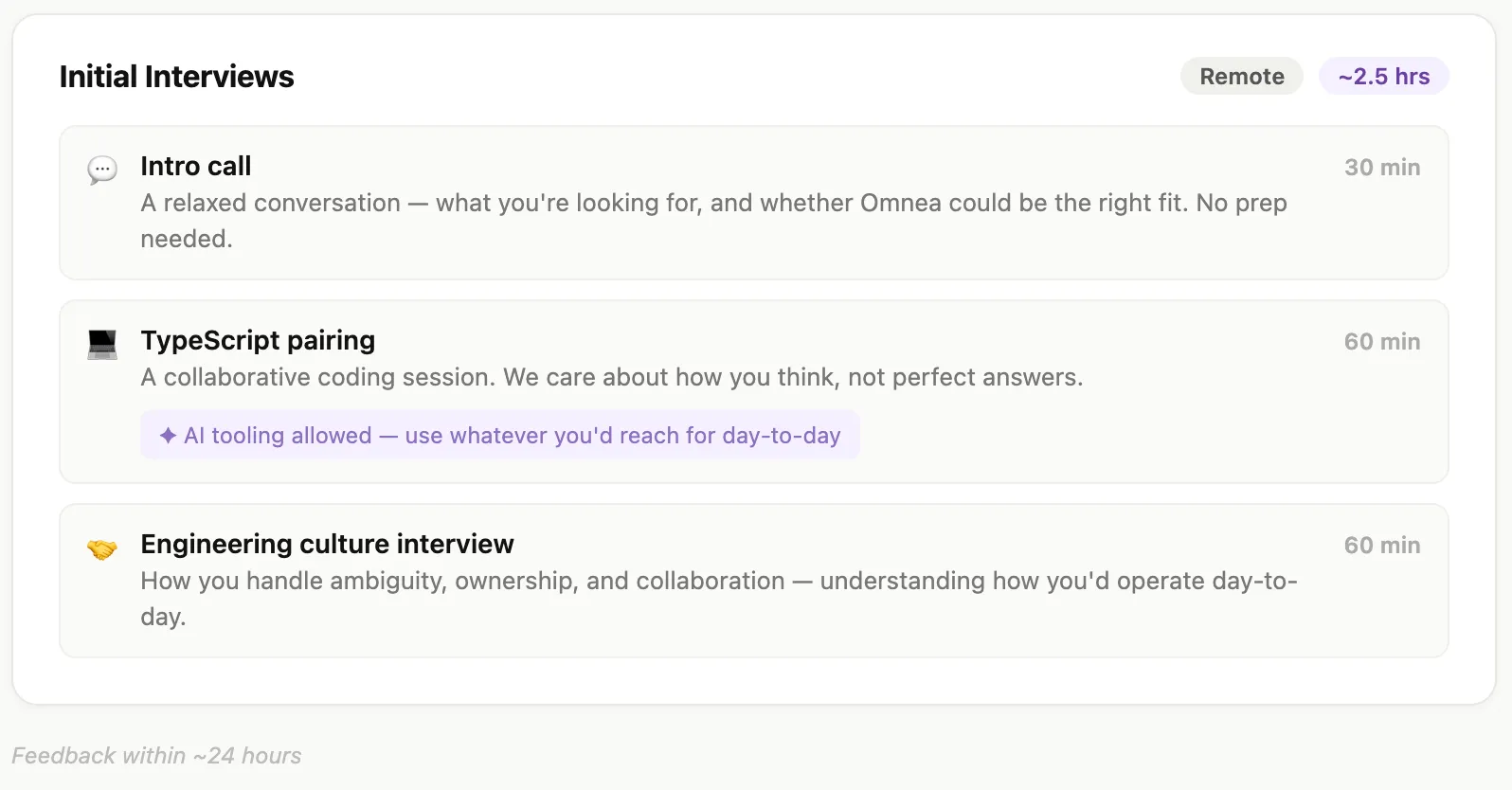
Intro call — 30 mins
A relaxed conversation to understand what you’re looking for, share more about Omnea, and figure out if it’s worth going further. No prep needed.
TypeScript pairing — 60 mins
A collaborative coding session. We’re not looking for a perfect answer — we’re looking at how you think, how you communicate while you’re working, and how you approach something unfamiliar. It should feel like working through a problem with a colleague, not being examined.
We think banning AI in interviews today is like banning Google ten years ago — it tests something artificial. We recently decided to allow AI tooling in the pairing challenge. Our engineers use it every day, so it would feel unnatural to ban it in an interview. We want this session to simulate what working with you would actually feel like — use whatever tools you’d reach for in a real situation.
Engineering culture interview — 60 mins
A conversation about how you actually work: how you handle ambiguity, how you’ve dealt with situations where you disagreed with the direction, how you think about ownership. This is where we’re trying to understand how you’d operate day-to-day, not just whether you can pass a test.
Stage 2: In-person Interviews, London (~2 hrs)
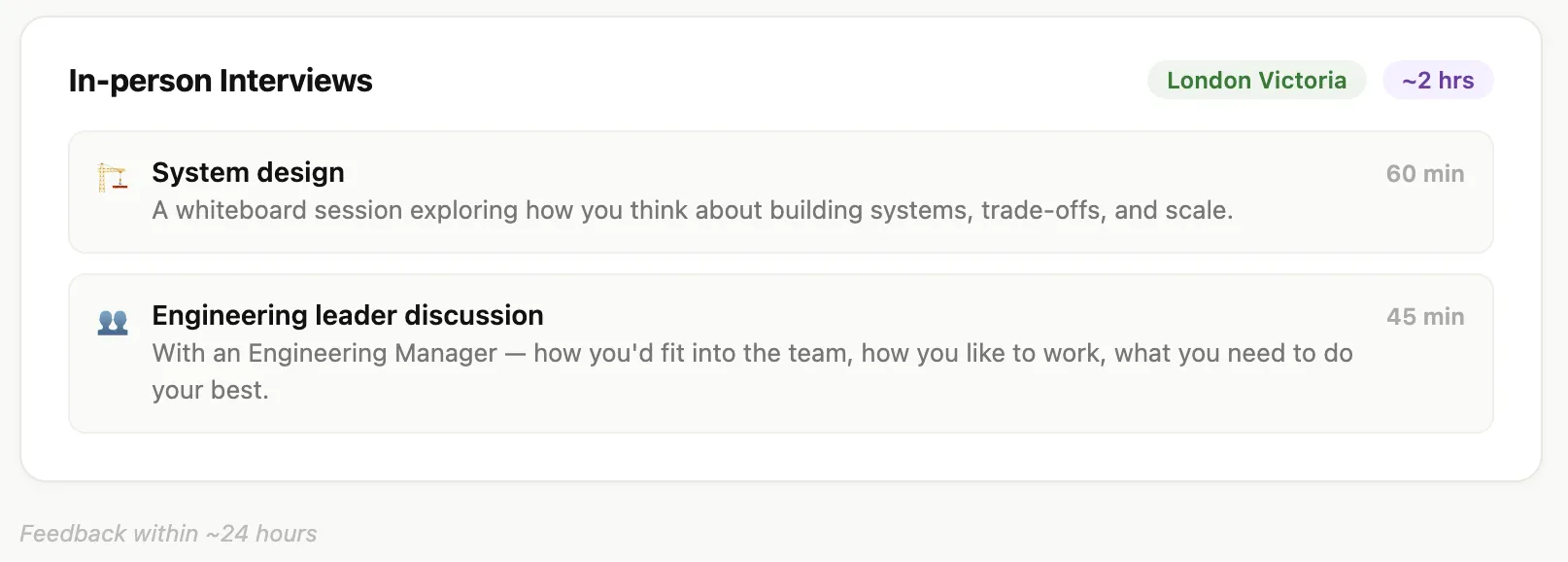
System design — 60 mins
A whiteboard session exploring how you think about building systems — the trade-offs you’d make, how you’d approach scale, how you communicate technical decisions.
Engineering Leader Discussion — 45 mins
Usually with an Engineering Manager. A deeper conversation about how you’d fit into the team, how you like to be managed, and what you need to do your best work.
Stage 3: Executive Interview — remote (45 mins)
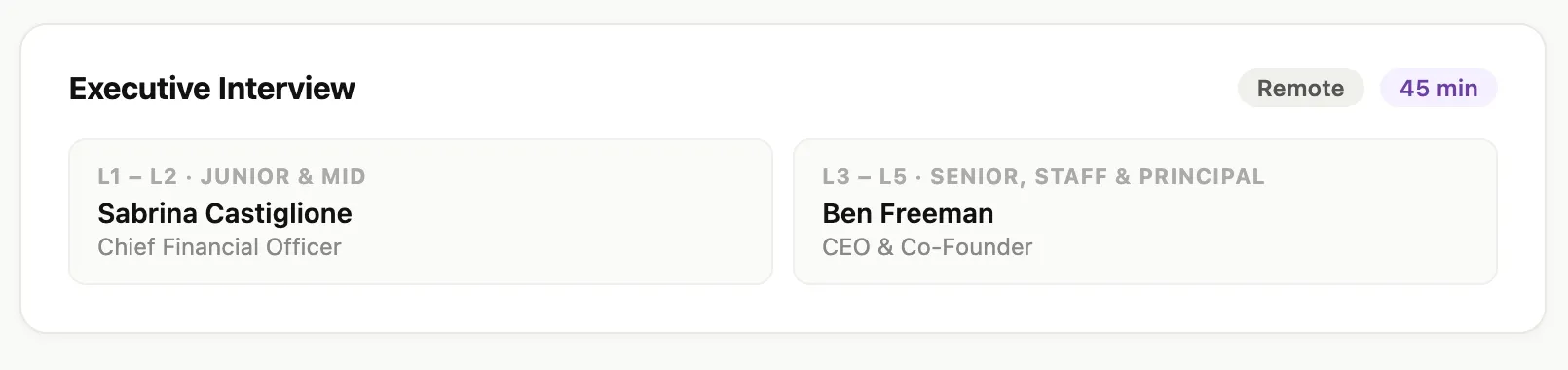
The final stage is a conversation with one of our executives, depending on the level of the role. For junior and mid-level positions (L1–L2), you’ll speak with Sabrina Castiglione, our CFO. For senior, staff, and principal roles (L3–L5), you’ll speak with Ben Freeman, our CEO and co-founder.It’s a genuine two-way conversation — what you want from your career, what we’re building, and whether this feels like the right place. It matters, so come prepared, but it’s not a gotcha.
What you can expect from us
Interviewing takes time and energy, and we don’t take that lightly. Before each stage we’ll tell you what’s involved, what we’re looking for, and who you’ll be speaking with — no surprises. We aim to share feedback within 24 hours of each stage, and we’re not looking for perfect answers, we’re looking for how you think. This is also a two-way process: ask us hard questions, challenge our thinking, and make sure Omnea feels like the right place for you.
A note on flexibility
If you’re already in other processes, or you need to move more quickly, just tell us. We can compress stages, run things in parallel, or adjust timing. We’d rather adapt than lose someone good because our process was too rigid.
If this sounds like you
If this sounds like the kind of environment you’d do your best work in, we should talk. We’re at a point where the hires we make over the next twelve months will genuinely shape what Omnea becomes.
If you’re a fullstack engineer who wants to be close to the problems, cares about building things that are actually useful, and you’re genuinely curious about how AI is changing what’s possible — we’d like to talk.
We also believe in being transparent with candidates before they even apply. Our R&D Candidate Hub has more on Omnea, how our engineering teams work, what we value, and what to expect from the process — no sign-up required.



" height="10.661279999999998px" id="LoeK6pYtS" transform="translate(0.27 5.262)" width="3.3432189999999995px"/><path d="M 7.025 0.035 C 6.902 0.019 6.771 0.012 6.64 0.004 C 4.768 -0.073 3.713 1.036 3.343 1.514 C 3.243 1.645 3.197 1.722 3.197 1.722 L 3.197 0.297 L 0 0.297 L 0 10.958 L 3.197 10.958 L 3.343 10.958 C 3.343 9.872 3.343 8.793 3.343 7.707 C 3.343 7.122 3.343 6.536 3.343 5.951 C 3.343 5.227 3.289 4.456 3.651 3.794 C 3.959 3.239 4.514 2.962 5.138 2.962 C 6.987 2.962 7.025 4.633 7.025 4.788 C 7.025 4.795 7.025 4.803 7.025 4.803 L 7.025 11.004 L 10.369 11.004 L 10.369 4.048 C 10.369 1.668 9.159 0.266 7.025 0.035 Z" fill="rgb(115, 112, 108)" height="11.004105999786248px" id="I8ZK_lI2U" transform="translate(5.631 4.996)" width="10.368549999999999px"/><path d="M 1.941 3.882 C 3.013 3.882 3.882 3.013 3.882 1.941 C 3.882 0.869 3.013 0 1.941 0 C 0.869 0 0 0.869 0 1.941 C 0 3.013 0.869 3.882 1.941 3.882 Z" fill="rgb(115, 112, 108)" height="3.8824500000000315px" id="BoA0OppHn" width="3.882450000000003px"/></g></svg>)
" height="12px" id="Gnx304Rz4" transform="translate(0 2.5)" width="16px"/></svg>)