Blog
Engineering
From one engineer to another: why procurement is a builder's dream
・ 8
min read

Henry Chong
Senior Engineering Manager

Greetings! Henry here, an engineering manager at Omnea. I came from a background in big tech and fintech, having worked on mass-market consumer products like Instagram for Creators and Business Banking.
If you told me last year I’d be working in procurement B2B SaaS (and loving it), I would have laughed and shown you the door. Before I saw it for myself, the p-word conjured up an grey landscape of drudgery, endless red tape and boredom. How could it possibly compete with the fast-paced world of social media or “hot coral” fintech?
I was proven wrong very quickly! Since joining, I’ve realised that procurement is the hidden gem of business problems, that technology can now solve today. It’s at the ultimate intersection of money, operations and risk. It’s where human creativity and decision making collides with the complexity of global workflows, data and integrations. And for an engineer, it’s a goldmine for innovation and impact, particularly for those at the forefront of AI and LLM developments.
In this post, I’ll share more of what I’ve learned, explain why procurement is the secret sauce to a truly successful company, and why you should join me in reshaping the core of business operations for the better!
Procurement is more than a transaction, it’s a mindset
In the simplest terms, procurement is the act of obtaining something. In the context of businesses, procurement is making sure you have all the things you need to run your business. In today’s hyper-connected global economy, every company depends on other companies to function - often with a complex web of software vendors, cloud providers, contractors, infrastructure, raw materials, logistics, services that are selected and stitched together to deliver a product or service. Procurement people govern that ecosystem, and it goes much deeper than saying yes or no to spending money. The procurement mindset is long-term, third-party management at scale. Procurement is delicate balancing act of:
Getting the right things in the door
Commercially, is this good value?
Operationally, how do we make it happen?
Legally, what considerations and requirements must be met?
Squashing risks before, during and after (for everything above, and more)
Covering all the above at vastly different timescales
Do we have what we need today?
How can we prepare for tomorrow?
With unlimited money and time, anyone can procure something. But because procurement touches so many parts of any organisation, with fragmented systems and the coordination required, being effective at procurement is not easy!
An example of what procurement actually looks like
A common misconception is viewing procurement as a directional workflow that goes from “we want to buy this” to “we’ve bought it”. That is part of procurement, but the reality is closer to an evolving lifecycle and some of the most challenging bits happen well after an initial decision was made. From an engineering perspective, it means that it’s not enough to build a state machine, chuck some forms on it and call it a day! And like real life, it doesn’t always go in a straight line, and the people involved don’t always agree.
Putting that nuance and complexity aside for now, a typical procurement lifecycle can look like:
Identifying a need (a tool, a service provider, an external partner…)
Translating this need into a request with enough context for others to evaluate it properly
Sourcing (a whole category of complexity in itself - what suppliers are best suited to meet this need?)
Finance needs to understand the cost and budget impact
Legal needs to review contractual terms and liability
Security and IT need to assess data, architecture and operational risks
Compliance may need to ensure regulatory requirements are met (especially in regulated industries).
Fun side story: my first exposure to Omnea was while I was still at Monzo, working on the Making Tax Digital tooling in Business Banking. As you can imagine - banks are highly regulated, so it’s no surprise we had an expert procurement team doing a lot of heavy lifting behind the scenes!
Coordinating the input, perspectives and feedback of all parties involved
but also keeping things moving quickly
Getting it done once everything is agreed
negotiating the best deal
making payments, logistics
onboarding suppliers
Staying on top of any changes, during and after a purchase is made
contract renewal - at which point a whole new procurement cycle might kick off
scopes shift - maybe the business strategy or markets adjust
risks can appear at any time - if the company grows, or the landscape changes, a supplier becomes more (or less) important to business operations
rinse and repeat across all business needs!
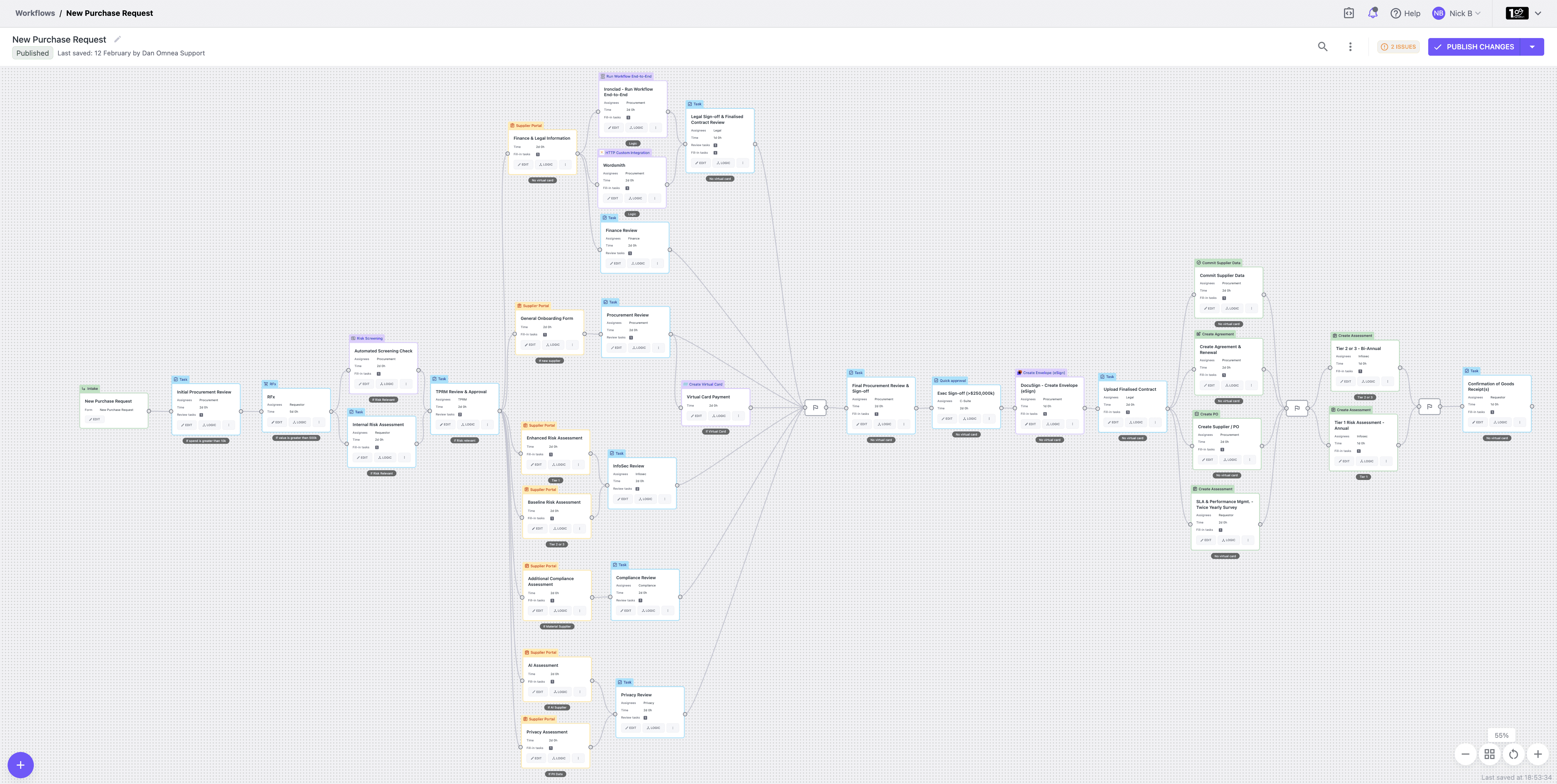
An example of a “New Purchase Request” workflow.
From outside procurement, it can often feel like the bottleneck because it’s the most visible part of the process, even if the underlying delay sits elsewhere.
From inside procurement, it’s a careful balance of managing complexity at large scales and making the right tradeoffs and decisions under pressure.
Why is procurement so challenging today?
Ben Freeman, our founder, realised during his time at Tessian and in conversation with business leaders that “finance and procurement leaders are fed up with seeing duplicative suppliers, missed renewals, and manually managed procurement processes“.
There’s many factors that feed the difficulty of procurement, but some of the core ones are:
It’s a rapidly evolving space
the way businesses buy things is changing and moving away from linear towards combinatorial complexity - in suppliers, systems and technical architecture. Procurement is one of the last major horizontal business functions to go beyond a loose patchwork of email, spreadsheets, long threads and duplicated questions
Buying power is decentralising
teams can often acquire tools and services directly with minimal friction - great for speed, but this creates fragmentation and risk without ways to coordinate decisions centrally
At an accelerating pace
think back across the rate of change in the last two, five, ten years. ChatGPT is only just over three years old; a blink of an eye for many companies! The bar for excellence and what businesses need to stay competitive is moving ahead incredibly quickly
With massive scales of data to consider
the number of options available have skyrocketed, the best options and the most dangerous risks are spread across information silos across the company, and without proper tooling, managing and using this key information for procurement is becoming exponentially harder
the average company has 125 tier-one suppliers, and each of these suppliers can involve a complex integration that wasn’t designed with a common language or interoperability in mind
Third party risks are more prevalent than ever, and need active governance
regulators globally are moving towards greater scrutiny
data breaches are more damaging in today’s technological landscape
supply chain disruptions and external dependencies are less stable than before
The good news: how we’re making procurement actually better
There’s a lot of challenges listed above. How can procurement be turned from a problem to an opportunity for CFOs and CEOs to win against their competition on cost control, operational resilience and scalability? We’re weaving these three elements throughout everything we do at Omnea:
A platform for coordination
We’re not here to replace every system in the stack. Like procurement itself, we’re focused on understanding the bigger picture, providing a super-powered coordination layer and an intelligent front door to everyone across the business.
We think deeply about how requests enter an organisation, how approvals route across teams, and how supplier data stays consistent. User delight is core to everything we do.
We connect with Slack, Teams, ticketing systems, ERPs (Enterprise Resource Planning software), AP (accounts payable) systems, CLMs (contract lifecycle management), and all the places where business operations already run today.
If this sounds like a fun technical and engineering challenge, you would be 100% correct (and we’ll share more soon enough on some of the problems we’ve successfully tackled on this road)
Artificial Intelligence, intelligently applied
With large language models (LLMs) hitting a level of maturity and quality, AI has reached a point where it can meaningfully assist with the kinds of problems procurement teams face every day.
Procurement workflows generate large volumes of semi-structured data, e.g contracts, questionnaires, documents and approval histories. These can be difficult to process manually at scale, but by embedding AI with clear guardrails directly into workflows, we can reduce the administrative burden involved and quickly surface relevant information throughout the procurement lifecycle.
A deep talent pool, with people who are obsessed with making an impact
In Engineering, Product, Design, Go-To-Market, Operations, Customer and in every role - we hold ourselves to an incredibly high talent bar, in order to ensure we have the very best folks with the talent, experience, grit and perseverance to tackle procurement and all its delightfully messy challenges.
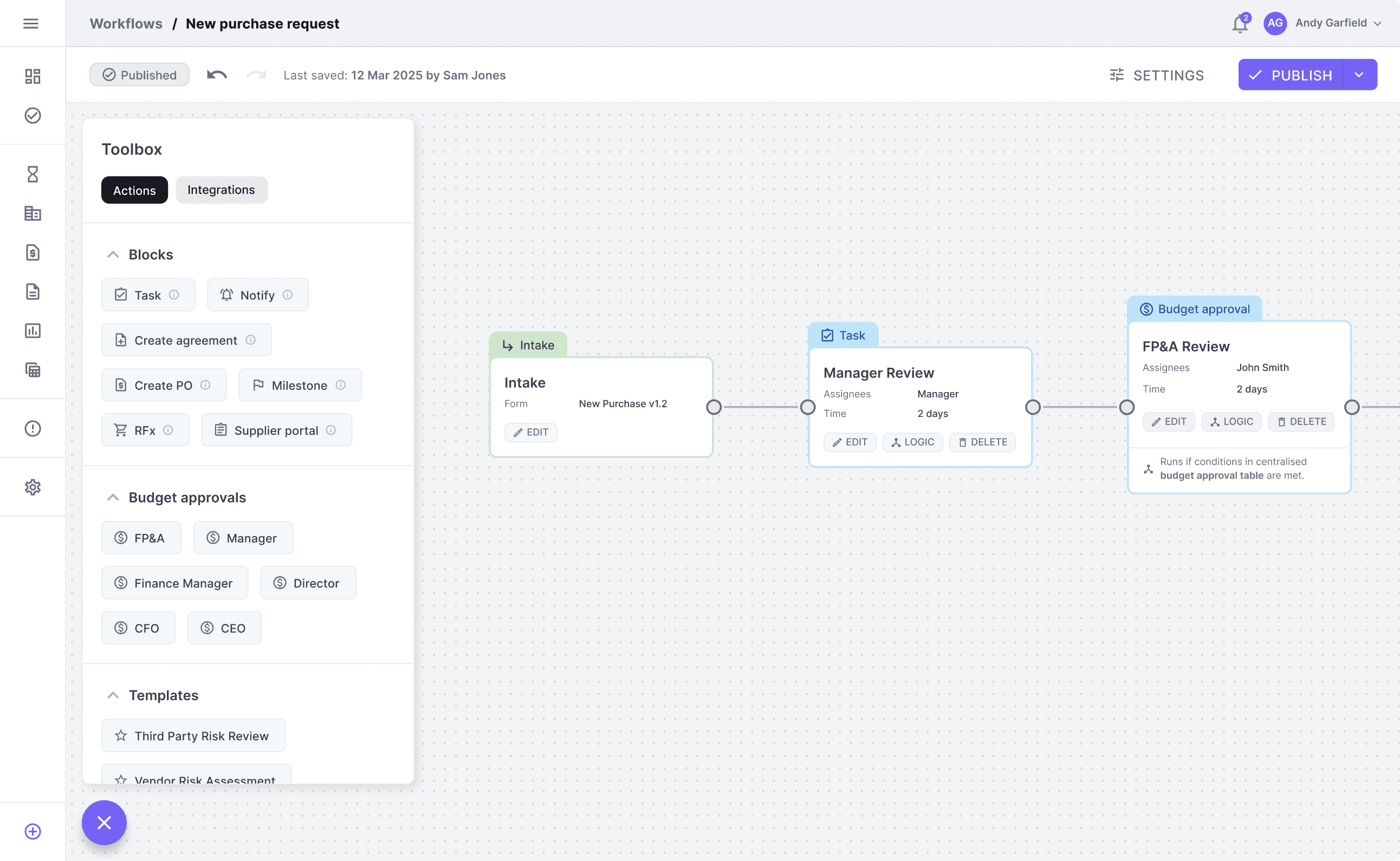
Screenshot of our flexible workflow builder. Users simply drag-and-drop from the left panel, and configure everything in one canvas.
We’re taking an intentional approach, because procurement doesn’t need another rigid suite that tries to do everything, but doesn’t go deep enough. Instead, we’re building a system that reflects how work actually happens across teams - one that makes complex coordination feel manageable, not overwhelming.
To solve this puzzle takes engineering and product minds
As I mentioned earlier, procurement wasn’t on my radar as a “big place to make an impact”. It seems obvious now, but I was (delightfully) surprised at the technical demands and opportunities in this space.
Procurement workflows are long-lived and stateful. The data models are complex and hierarchical. The user base spans multiple personas with conflicting incentives. The constraints - legal, financial, regulatory - are real and non-negotiable. And adoption is unforgiving; if the experience doesn’t work for users, they will bypass it immediately. Getting it right is basically winning 4D chess!
And of course, there’s the two magic letters that are perfectly positioned to summarise, reason, infer and ultimately assist people in the procurement space. You guessed it - AI.
When I mentioned that we embed AI into workflows earlier, we don’t just throw a prompt at it and call it a day. We track the performance of the different LLMs closely, using the best one for the specific outcomes we need for a given product experience (speed, accuracy, lots of different dimensions). We’re gathering the right context in smart ways, from documents to websites and so much in between. We’ll stream and chunk requests, think through tokens carefully, and are constantly iterating and pushing at the edge of what can be done with these rapidly evolving tools.
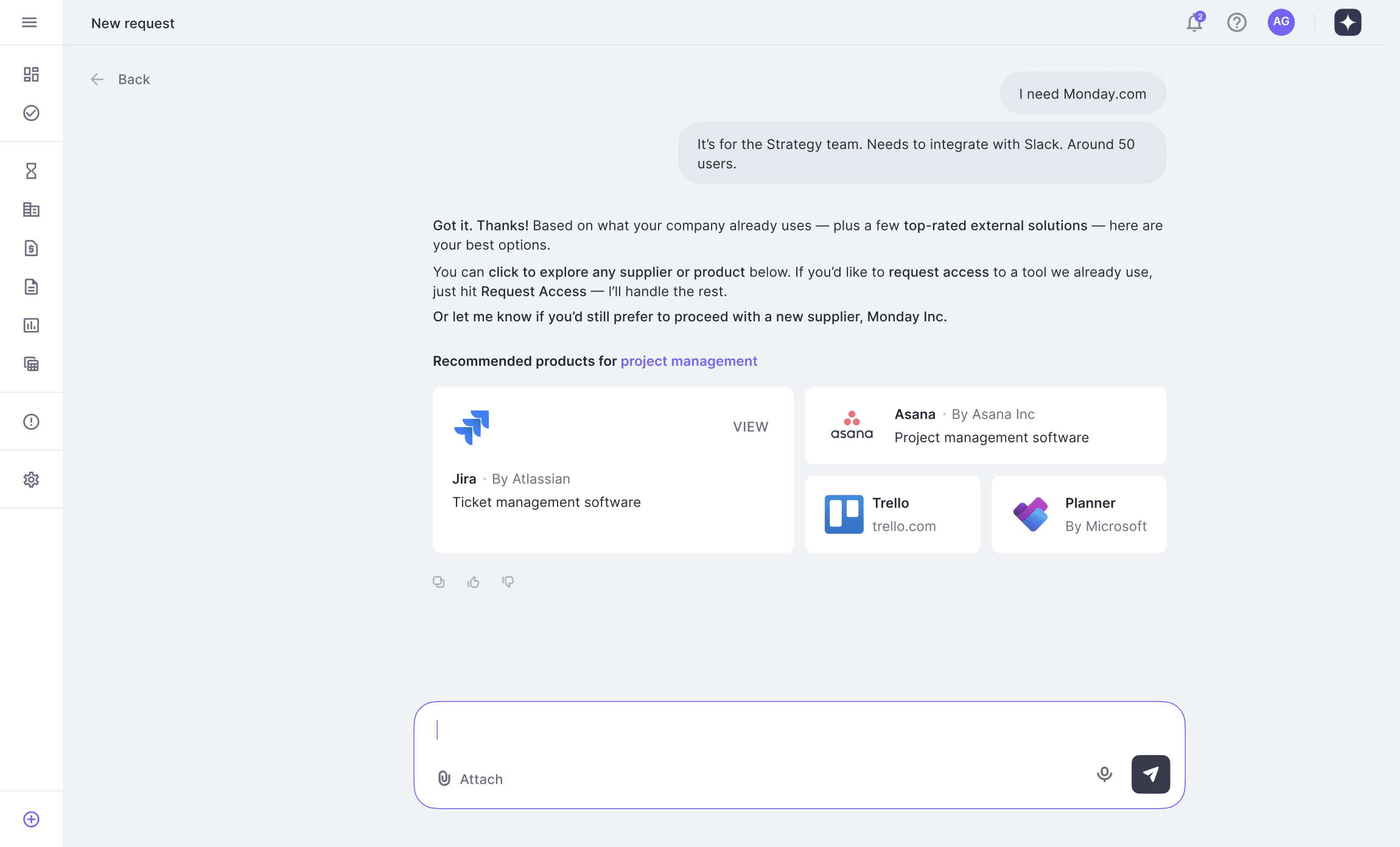
One of many applications of AI in Omnea, product recommendations via natural language requests.
Building great procurement software means encoding how organisations make decisions about money and risk. It’s designing systems that can handle ambiguity, change over time gracefully, and operate reliably across many stakeholders. You’re balancing freedom with control, and massive scale with flexibility. Those are hard problems, and they’re hard in ways that are grounded in reality rather than abstraction. While it’s only been a few months into my time here, it’s been rewarding to see the tangible, positive outcomes that we’re having across so many businesses by empowering procurement.
Final thoughts
We’re at the end of our whistle-stop tour of the wonderful world of procurement, so if you take one message away, it’s this: procurement is more than just buying stuff. It’s how a company fundamentally balances speed, control, and resilience through creative management of dependencies. I hope this peek behind the curtain makes it obvious why procurement is having a moment, and why it’s such an interesting space to build in.
Interested in a role at Omnea, but still worried you don’t get procurement? Don’t worry, I didn’t either! All you need is a curious mindset, a fearless approach to tackling complexity, and an appreciation of the real world and its constraints. Join us to build great software that procurement deserves, and redefine how organisations operate for the better! You can find all open roles on our careers page.




" height="10.661279999999998px" id="LoeK6pYtS" transform="translate(0.27 5.262)" width="3.3432189999999995px"/><path d="M 7.025 0.035 C 6.902 0.019 6.771 0.012 6.64 0.004 C 4.768 -0.073 3.713 1.036 3.343 1.514 C 3.243 1.645 3.197 1.722 3.197 1.722 L 3.197 0.297 L 0 0.297 L 0 10.958 L 3.197 10.958 L 3.343 10.958 C 3.343 9.872 3.343 8.793 3.343 7.707 C 3.343 7.122 3.343 6.536 3.343 5.951 C 3.343 5.227 3.289 4.456 3.651 3.794 C 3.959 3.239 4.514 2.962 5.138 2.962 C 6.987 2.962 7.025 4.633 7.025 4.788 C 7.025 4.795 7.025 4.803 7.025 4.803 L 7.025 11.004 L 10.369 11.004 L 10.369 4.048 C 10.369 1.668 9.159 0.266 7.025 0.035 Z" fill="rgb(115, 112, 108)" height="11.004105999786248px" id="I8ZK_lI2U" transform="translate(5.631 4.996)" width="10.368549999999999px"/><path d="M 1.941 3.882 C 3.013 3.882 3.882 3.013 3.882 1.941 C 3.882 0.869 3.013 0 1.941 0 C 0.869 0 0 0.869 0 1.941 C 0 3.013 0.869 3.882 1.941 3.882 Z" fill="rgb(115, 112, 108)" height="3.8824500000000315px" id="BoA0OppHn" width="3.882450000000003px"/></g></svg>)
" height="12px" id="Gnx304Rz4" transform="translate(0 2.5)" width="16px"/></svg>)